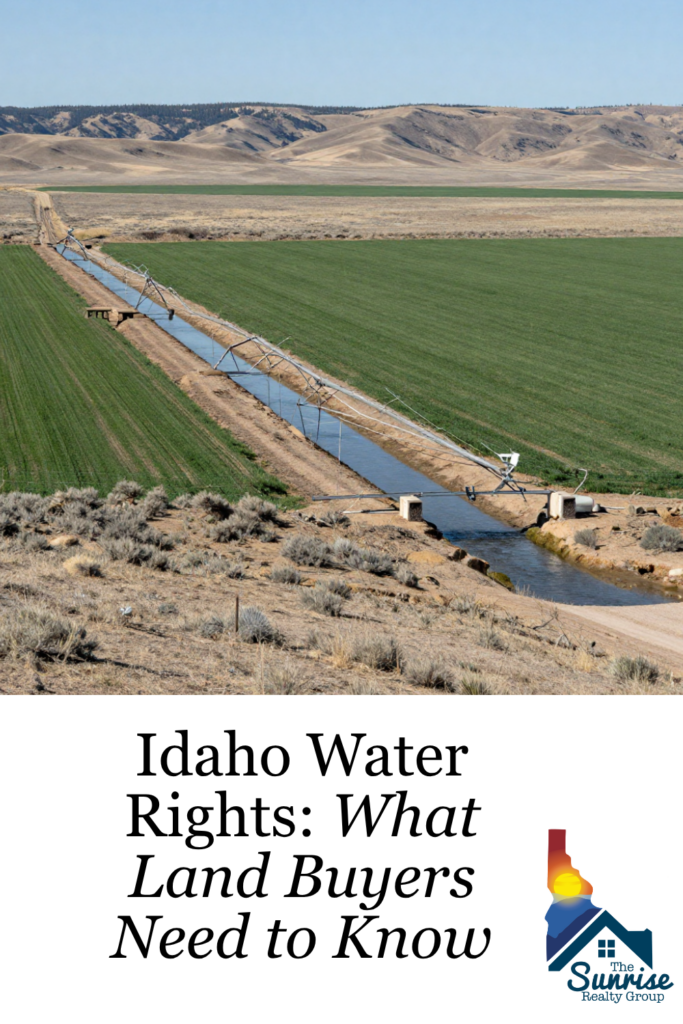
Idaho water rights can have a major impact on what you can do with a piece of land, how the property is valued, and whether it supports your long-term plans.
This is particularly important for buyers considering acreage, agricultural property, rural homesites, custom-home lots, or land intended for future development.
One of the easiest mistakes to make is assuming that owning land automatically gives you the right to use whatever water is on, under, or next to it.
Idaho doesn’t work that way.
Water use is governed by a system of established rights, priority dates, authorized uses, diversion points, and other conditions. Depending on the property, you may also be dealing with a private well, irrigation company shares, canal water, a municipal system, or some combination of those.
Understanding the basics of Idaho water rights before buying can help you identify questions that need to be answered before they become expensive problems.
How Idaho Water Rights Work
Idaho follows the prior appropriation doctrine, commonly summarized as:
First in time, first in right.
In simple terms, water rights with earlier priority dates generally have priority over later, or junior, rights when there isn’t enough water to satisfy everyone.
That means two neighboring properties can have access to the same water source but have very different legal rights to use it.
A water right can contain important elements such as:
- Priority date
- Source of water
- Point of diversion
- Place of use
- Type or purpose of use
- Diversion rate
- Authorized volume
- Period of use
- Other conditions
For a land buyer, simply being told that a property “has water rights” isn’t enough.
You need to understand what rights exist and what those rights actually authorize.
What Does “First in Time, First in Right” Mean?
Priority becomes especially important when water supplies are limited.
Generally, senior water rights are administered ahead of junior rights.
If there isn’t enough water to satisfy all rights, junior users may have their water curtailed while senior rights continue to receive water according to the applicable administration of those rights.
That’s why the priority date matters.
An older water right can occupy a very different position from a newer one even when both properties otherwise look similar.
However, don’t assume the priority date is simply the year the current owner began using the property.
Priority is tied to how and when the particular water right was legally established.
The official water-right record is where buyers should look for that information.
Owning Land Doesn’t Automatically Create a Water Right
Idaho water belongs to the public, and a landowner’s ability to divert and use water depends on the existence of an applicable water right, exemption, water-service arrangement, or other lawful authorization.
That means buying a parcel next to a river doesn’t automatically give you permission to divert river water.
Likewise, owning acreage doesn’t automatically mean you can drill a well and use unlimited groundwater for whatever purpose you choose.
The property and the water authorization need to be evaluated separately.
However, that does not mean water rights always stay separate when land is sold.
Do Idaho Water Rights Transfer With the Property?
This is an important distinction for buyers.
Water rights that are appurtenant to real property generally pass with that property when it is conveyed unless the rights are expressly reserved or the transaction clearly provides otherwise.
In other words, you shouldn’t assume either extreme:
- Don’t assume that every mention of water automatically means a valid water right comes with the property.
- But don’t assume that an existing appurtenant water right has to be separately listed and sold as an unrelated asset either.
The transaction documents, chain of title, water-right records, and any reservations need to be reviewed together.
New owners of established water rights should also make sure the Idaho Department of Water Resources has accurate ownership information.
When water is important to your plans, confirm the rights as part of due diligence rather than relying solely on a listing description such as “irrigation available” or “water rights included.”
Who Administers Idaho Water Rights?
The Idaho Department of Water Resources, or IDWR, administers the state’s water-right system.
IDWR maintains water-right records and handles matters involving areas such as:
- Water-right permits
- Licenses
- Transfers
- Ownership changes
- Adjudication records
- Water administration
- Water-right research
- Certain enforcement and curtailment matters
Within established water districts, watermasters play an important role in administering water distribution according to recognized water rights and priority.
For buyers, IDWR’s records are an important starting point when researching what water rights are associated with a property.
Beneficial Use Is Central to Idaho Water Law
A central concept in Idaho water law is beneficial use.
Recognized beneficial uses can include:
- Domestic use
- Irrigation
- Stockwater
- Municipal use
- Commercial or industrial uses
- Hydropower
- Aquaculture
- Recreation
- Fish and wildlife uses
A water right isn’t simply permission to possess water indefinitely without regard to how it is used.
The right is defined in part by the authorized beneficial use.
This matters when buying land for a new purpose.
For example, an irrigation water right should not automatically be treated as permission to use that water for a completely different purpose or at a different location.
Changes to established elements of a water right may require approval.
Can an Idaho Water Right Be Lost Through Nonuse?
Potentially.
Idaho law includes forfeiture provisions related to extended nonuse. A water right, or portion of one, may be subject to forfeiture after a continuous five-year period of nonuse.
But “use it or lose it” is an oversimplification.
There are statutory exceptions and circumstances that can affect whether nonuse results in forfeiture.
For a buyer, the useful question isn’t simply:
“Is there a water right on paper?”
It’s also:
“What is the current status and history of that right?”
If an important water right hasn’t been used for years, additional investigation may be appropriate before relying on it for the property’s value or your future plans.
Priority Dates Can Affect the Reliability of Water
A water right’s priority date helps determine its standing relative to other rights during water shortages.
Generally:
- Older rights are more senior.
- Newer rights are more junior.
- Senior rights are administered before junior rights when available water is insufficient.
This does not mean every junior right is inherently unusable or undesirable.
It means buyers need to understand the right within the context of its source, location, priority, water district, and intended use.
This can be especially important for agricultural land or property where irrigation is a significant part of its value.
Surface Water and Groundwater Can Be Connected
It’s easy to think of river water and groundwater as two completely separate systems.
Hydrologically, they may not be.
Idaho has rules for the conjunctive management of surface water and groundwater where the two sources are connected.
In certain situations, groundwater pumping can affect surface-water users.
That means a groundwater right isn’t necessarily insulated from water shortages or administration simply because the water comes from a well.
Idaho’s conjunctive-management system allows priority administration to address injury to senior rights associated with connected water sources.
For buyers, the key lesson is simple:
A well does not automatically mean the water supply exists outside the larger water-right system.
What About Domestic Wells?
Private domestic wells deserve special attention because they are common on rural Idaho property.
Certain qualifying domestic groundwater uses are exempt from the standard permit requirement.
Current Idaho law defines qualifying domestic uses using specific limits involving the amount and purpose of water use. One common category is water for homes and related uses, such as irrigation of up to one-half acre, provided total use remains within the applicable statutory limit.
That does not mean every well is unlimited or that every proposed use qualifies as exempt domestic use.
Questions to investigate can include:
- Does a well already exist?
- Is there a well log?
- What is the well depth?
- What has the well historically supplied?
- Does the proposed use fall within a domestic exemption?
- Are you planning more irrigation than the exemption allows?
- Will the property have more than one residence?
- Does the development require a different water-right structure?
- Are there subdivision, HOA, health-district, or other restrictions that affect the plan?
If you’re buying acreage because you want a home, large irrigated landscape, shop, livestock, additional dwelling, or another significant use, don’t assume the words “private well” answer all of those questions.
Irrigation Water May Work Differently
Another important issue for Treasure Valley buyers is irrigation water.
A property may receive irrigation water through an irrigation district, canal company, ditch company, or another delivery organization.
In some cases, the individual landowner does not personally hold the underlying appropriation. Instead, the landowner may have shares or another right to receive water from the organization that holds the water right.
That creates an important distinction between:
having a water right and having a right to receive irrigation water.
When evaluating irrigated property, buyers may need to determine:
- Who supplies the irrigation water?
- Are there shares associated with the property?
- How are those shares conveyed?
- What acreage is served?
- What assessments or fees apply?
- Where are the delivery points?
- Are ditches or easements involved?
- What is the typical delivery season?
- Has the water historically been used on the parcel?
“Has irrigation” is a starting point for investigation—not the end of it.
Changing an Idaho Water Right May Require Approval
A water right is defined by more than its quantity.
Changes involving elements such as the:
- Point of diversion
- Place of use
- Period of use
- Nature or purpose of use
may require an approved water-right transfer through IDWR.
Transfers are reviewed in part to determine whether the proposed change would injure other water rights.
This becomes especially important when land is changing uses.
For example, agricultural property being converted to residential development may involve very different water needs and infrastructure than the original farming operation.
You shouldn’t assume an existing agricultural water right can simply be moved, repurposed, or expanded however the new owner wants.
Why Adjudication Matters
A water-right adjudication is a court process used to determine existing water rights within a river basin.
One of Idaho’s most significant examples is the Snake River Basin Adjudication, or SRBA.
The SRBA resulted in a Final Unified Decree in 2014 and determined a vast number of water rights throughout the Snake River Basin, although certain qualifying de minimis domestic and stockwater uses were allowed to be deferred.
For a buyer, an adjudicated water right can provide important information about legally determined elements of the right.
IDWR also has water-right and adjudication search tools that can help identify records associated with particular rights.
If the water situation is complicated, professional assistance may be needed to interpret what those records mean for a specific transaction or development plan.
Why Idaho Water Rights Matter When Buying Land
Water can affect far more than whether the grass stays green.
Depending on the property, Idaho water rights can influence:
- Agricultural use
- Irrigated acreage
- Livestock plans
- Development feasibility
- Well use
- Property value
- Site planning
- Future land use
- Financing considerations
- Resale
- The cost of developing the property
A property can have beautiful acreage, good road access, favorable zoning, and an ideal home site while still presenting a major problem if the buyer’s intended water use isn’t supported.
That’s why water needs to be part of land due diligence from the beginning.
Questions to Ask Before Buying Idaho Land
You don’t need to become a water-law expert before purchasing property.
But you should know which questions need answers.
Before relying on water for a property, consider asking:
- What is the property’s water source?
- Are there recorded water rights associated with the property?
- Who owns those rights?
- What are the water-right numbers?
- What are the priority dates?
- What uses are authorized?
- What acreage or place of use is covered?
- Where is the point of diversion?
- Has the water historically been used?
- Is irrigation supplied by a district or canal company instead?
- Are shares involved?
- Does a private well exist?
- Is the proposed use within any applicable domestic exemption?
- Would the intended development require a water-right change or new authorization?
- Are there easements associated with irrigation infrastructure?
- Does the water situation support what you actually intend to do with the property?
The last question is the most important.
A water arrangement that works perfectly for one buyer’s plans may be inadequate for another’s.
Don’t Evaluate Water Separately From the Rest of the Property
Water rights are only one part of deciding whether Idaho land is right for a particular project.
They need to be evaluated alongside:
- Zoning
- Legal descriptions
- Property boundaries
- Easements
- Access
- Utilities
- Septic feasibility
- Topography
- Building setbacks
- Development requirements
- Home design
- Total project budget
These issues overlap.
Where water can legally be used may affect where and how land can be developed. Irrigation infrastructure may create easements across the property. A proposed subdivision can change the water analysis entirely.
For someone planning to build, the right question isn’t simply:
“Does this property have water?”
It’s:
“Does this property’s water situation support what I want to build and how I want to use the land?”
Idaho Water Rights Should Be Verified Before You Buy
Idaho water rights can be valuable, complicated, and easy to misunderstand.
The most important points for land buyers are:
- Land ownership alone does not create a right to use water.
- Priority matters when water supplies are insufficient.
- Existing appurtenant water rights may pass with property unless properly reserved or otherwise addressed.
- The authorized use of a water right matters.
- Changes to a right may require IDWR approval.
- Domestic wells have rules and limitations.
- Irrigation delivery rights and water-right ownership are not always the same thing.
- Nonuse can create potential forfeiture issues.
- Surface water and groundwater may be administered together.
Most importantly, don’t rely on a listing description or an assumption when water is essential to your plans.
Verify the records, understand the source, and make sure the available water fits the actual property use you’re considering.
Buying or Building on Land in the Treasure Valley?
If you’re considering land in Boise or elsewhere in the Treasure Valley, water is one part of a much larger due-diligence process.
Sunrise Realty Group helps buyers look beyond acreage and listing photos to understand how the land, home design, builder, development requirements, and overall project fit together.
Our 3-One Method brings those pieces into one connected process so buyers can make better-informed decisions before committing to a property that doesn’t support their plans.
Because when you’re buying land to build a home, finding the right property is only the beginning.
You also need to make sure the property can support the life you intend to build on it.