Category: Purchasing

  • What Are CC&Rs in Idaho? HOA Rules Buyers Should Know

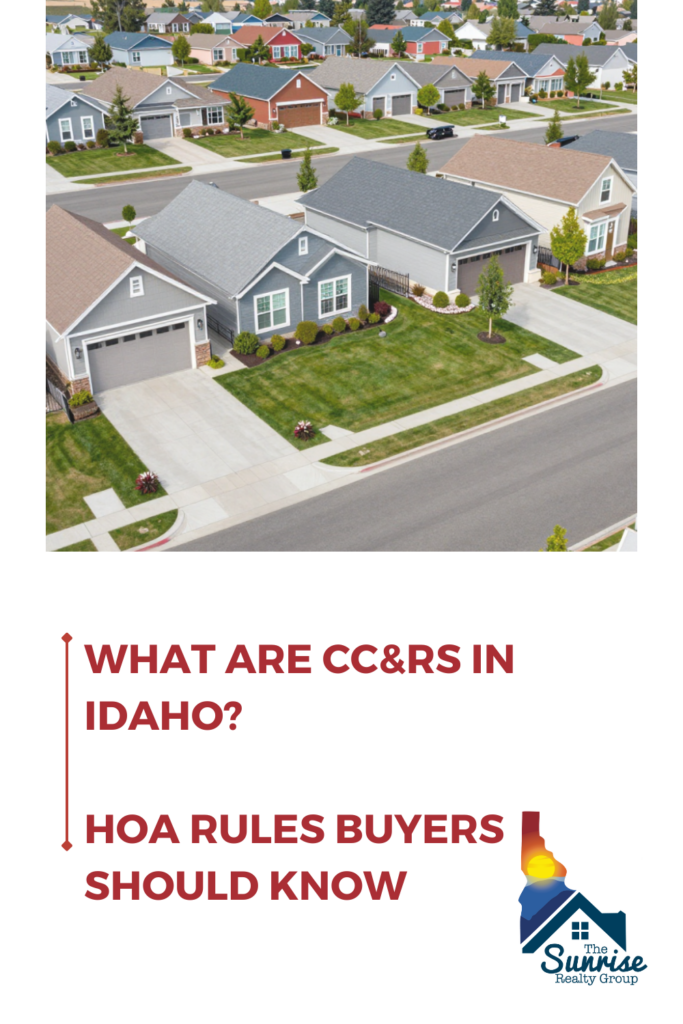
    If you’re considering a home in a planned community, understanding CC&Rs in Idaho should be part of your due diligence before you buy.

    CC&Rs—short for Covenants, Conditions, and Restrictions—can affect how you use, maintain, rent, improve, and even park vehicles on your property.

    They may regulate everything from exterior paint colors and fences to RV storage, landscaping, architectural changes, assessments, and certain property uses.

    For buyers, the important point is simple:

    You aren’t just evaluating the house.

    You also need to understand the recorded restrictions that may come with the property.

    Here’s what Idaho homebuyers should know about CC&Rs, how they relate to an HOA, and what to review before closing.

    What Are CC&Rs?

    CC&Rs are recorded covenants, conditions, and restrictions that establish rules and obligations affecting property within a community or development.

    They are typically recorded in the county land records and are intended to run with the land, meaning applicable restrictions continue to affect the property as ownership changes.

    CC&Rs may establish:

    • Property-use restrictions
    • Maintenance responsibilities
    • Architectural standards
    • Assessment obligations
    • HOA authority
    • Common-area responsibilities
    • Enforcement procedures
    • Owner rights and responsibilities

    When you purchase property subject to recorded CC&Rs, those restrictions don’t disappear simply because you weren’t the owner when they were created.

    That is why reviewing them before buying matters.

    Are CC&Rs the Same Thing as an HOA?

    Not exactly.

    The CC&Rs are the recorded restrictions and obligations affecting the property.

    The homeowners association, or HOA, is the organization that may administer and enforce those restrictions within the community.

    Many HOA communities have CC&Rs that establish or define the association’s authority.

    However, recorded restrictive covenants can also exist in some neighborhoods even when there is no active HOA managing the community.

    For buyers, that means seeing “no HOA” on a listing does not necessarily answer every question about private restrictions.

    Title documents and recorded property records may still reveal covenants affecting the property.

    Why Do CC&Rs Exist?

    CC&Rs are generally created to establish expectations for how property within a development will be used and maintained.

    Depending on the community, they may be intended to:

    • Establish consistent development standards
    • Define owner and HOA responsibilities
    • Regulate property appearance
    • Protect common areas
    • Establish maintenance requirements
    • Create assessment obligations
    • Limit certain uses
    • Provide procedures for managing the community

    Some buyers appreciate the predictability that comes with established community standards.

    Others prefer fewer private restrictions and more flexibility over their property.

    Neither preference is inherently right or wrong.

    What matters is knowing which environment you’re buying into before you own the property.

    Breaking Down Covenants, Conditions, and Restrictions

    The phrase sounds complicated, but the basic idea is easier to understand when broken apart.

    Covenants

    A covenant is generally a promise or obligation connected to the property.

    Depending on the community, covenants might address things such as:

    • Maintaining landscaping
    • Maintaining portions of the property
    • Following architectural requirements
    • Paying required assessments
    • Maintaining certain exterior standards

    Because recorded covenants can run with the land, these obligations can continue from one property owner to the next.

    Conditions

    Conditions may establish requirements affecting property ownership, use, or particular rights within the community.

    Examples might involve:

    • Requirements for use of community amenities
    • Conditions affecting particular lots
    • Approval requirements
    • Responsibilities connected to common facilities

    The exact meaning and effect depend on the language of the governing documents.

    Restrictions

    Restrictions tell owners what uses or activities are limited or prohibited.

    Depending on the community, these can address:

    • Exterior modifications
    • Fencing
    • Parking
    • RVs, boats, or trailers
    • Signs
    • Rentals
    • Landscaping
    • Pets or animals
    • Home-based activities
    • Accessory structures

    Restrictions tend to be the part of CC&Rs that buyers notice most because they can directly affect how someone plans to use the property.

    What Do CC&Rs in Idaho Commonly Regulate?

    Every community is different, which is why buyers should read the actual documents affecting the property instead of assuming one HOA works like another.

    Still, several issues frequently appear in CC&Rs.

    Exterior Appearance and Improvements

    CC&Rs may regulate:

    • Exterior paint
    • Roofing materials
    • Fencing
    • Landscaping
    • Sheds
    • Pergolas
    • Patios
    • Garages
    • Additions
    • Other exterior improvements

    Some communities require architectural approval before certain modifications can begin.

    This can matter significantly if you’re buying a house because you already have renovation or expansion plans.

    A city building permit and HOA approval are also two different things.

    Receiving municipal approval does not necessarily mean a project satisfies private CC&R requirements.

    Vehicles and Parking

    Communities may have rules addressing:

    • Street parking
    • Driveway parking
    • Commercial vehicles
    • RVs
    • Boats
    • Trailers
    • Stored or inoperable vehicles

    If you own an RV, work truck, boat, trailer, or several vehicles, these restrictions deserve attention before buying.

    The time to discover that your RV can’t be stored beside the house is not after you’ve moved in.

    Property Maintenance

    CC&Rs may establish responsibilities involving:

    • Lawn and landscaping maintenance
    • Exterior repairs
    • Fence maintenance
    • Trash-container storage
    • Snow removal
    • Weed control
    • Other property conditions

    They may also define which areas the homeowner maintains and which areas are the HOA’s responsibility.

    Assessments and Fees

    CC&Rs often establish the HOA’s authority to collect assessments used for community expenses.

    Depending on the development, these expenses might support:

    • Common-area maintenance
    • Landscaping
    • Private roads
    • Community amenities
    • Insurance
    • Management
    • Other shared expenses

    Buyers should understand more than the current monthly or annual dues.

    They should also investigate whether there are outstanding assessments, transfer-related charges, upcoming expenses, or other financial obligations associated with the property or association.

    What About Rental Restrictions?

    Rental rules deserve particularly careful review because Idaho law places limits on what homeowners associations can do with certain rental restrictions.

    A buyer should determine whether valid rental restrictions already apply to the property and review the actual recorded documents rather than relying on a general statement such as “rentals allowed” or “no short-term rentals.”

    This becomes especially important if you are purchasing the property with plans to:

    • Rent it later
    • Use it as an investment property
    • Convert it to a rental after moving
    • Use it for short-term occupancy

    Existing restrictions, later amendments, and Idaho law can interact differently depending on the circumstances.

    If rental ability is financially important to the purchase, verify it before closing rather than assuming it can be figured out afterward.

    How Are CC&Rs Enforced in Idaho?

    In an active HOA community, enforcement is generally handled by the association through its board, management company, or another authorized agent.

    However, an HOA does not simply have unlimited authority to issue penalties however it chooses.

    In Idaho, an HOA’s ability to impose fines is subject to statutory requirements.

    Among other things, the authority to fine must be provided for in the covenants and restrictions. Idaho law also establishes notice and board-vote requirements before certain fines may be imposed.

    The exact process can depend on:

    • Idaho law
    • The CC&Rs
    • Association rules
    • The type of violation
    • The remedy being pursued

    Depending on the issue and governing documents, enforcement can involve measures such as:

    • Violation notices
    • Opportunities to address the problem
    • Fines when legally authorized
    • Collection action for certain unpaid obligations
    • Recorded liens in circumstances allowed by law
    • Legal action

    Buyers should therefore read not only the list of prohibited activities but also the provisions explaining how the association can enforce them.

    Can an HOA Selectively Enforce the Rules?

    The original version of this question often gets answered too simply.

    It isn’t accurate to say that an HOA can never enforce a rule against one owner unless every other similar violation has also been pursued.

    At the same time, inconsistent, arbitrary, discriminatory, or otherwise improper enforcement can potentially create legal issues.

    The circumstances matter.

    If you’re involved in an actual enforcement dispute, questions about waiver, selective enforcement, discrimination, interpretation of the governing documents, or the HOA’s authority are better addressed by a qualified attorney than by assumptions about what the association “has to” do.

    For a buyer, the more practical question is:

    How actively does this particular HOA enforce its rules?

    That is something worth investigating before you purchase.

    Are CC&Rs the Same as Local Law or Zoning?

    No.

    CC&Rs are private property restrictions.

    Zoning, building codes, and other land-use requirements come from governmental authorities.

    A property can therefore be subject to both.

    For example, local zoning might allow a particular type of accessory structure while the property’s CC&Rs prohibit it or impose additional design requirements.

    Private restrictions generally cannot authorize something that applicable law prohibits.

    And applicable state or federal law can also limit whether certain CC&R provisions are enforceable.

    That’s why buyers shouldn’t treat either zoning approval or HOA approval as the complete answer when planning a project.

    Both may need to be reviewed.

    CC&Rs vs. Bylaws vs. HOA Rules

    HOA communities typically have several different governing documents.

    Understanding their roles makes them easier to review.

    CC&Rs

    CC&Rs generally establish the primary recorded property restrictions, owner obligations, assessment authority, and significant powers of the association.

    Articles of Incorporation

    If the HOA is incorporated, its articles establish the legal entity and contain certain foundational corporate information.

    Bylaws

    Bylaws generally address how the association itself operates.

    They may cover matters such as:

    • Board positions
    • Elections
    • Meetings
    • Voting
    • Officer responsibilities
    • Association procedures

    Rules and Regulations

    Rules and regulations tend to address more specific day-to-day community policies.

    These might include detailed rules concerning:

    • Pools
    • Clubhouses
    • Parking
    • Common areas
    • Amenity hours
    • Architectural procedures

    The governing documents work together and are also subject to applicable Idaho and federal law.

    Rather than assuming a universal hierarchy will answer every conflict, buyers should review the complete set of applicable documents when a particular restriction matters to them.

    Can CC&Rs Be Changed?

    Yes.

    Recorded covenants are not necessarily permanent in exactly the same form forever.

    They may be amended according to the procedures and voting requirements that apply to the community and applicable law.

    The amendment process can involve:

    • Required owner approval
    • Board action where authorized
    • Written documentation
    • Recording an amendment
    • Other procedural requirements

    The percentage of owners required to approve an amendment is not universally the same for every Idaho community.

    That is why buyers shouldn’t rely on a blanket statement such as “CC&Rs require a 75% vote to change.”

    Review the actual declaration and applicable law.

    What Should Idaho Buyers Review Before Purchasing in an HOA?

    If you’re considering a property governed by an HOA, don’t treat the document package as paperwork to skim after you’ve already emotionally committed to the house.

    Review it as part of your buying decision.

    Pay particular attention to:

    • Current CC&Rs and amendments
    • HOA bylaws
    • Rules and regulations
    • Current assessments
    • Special assessments
    • Architectural requirements
    • Rental provisions
    • Parking rules
    • RV, boat, and trailer restrictions
    • Pet or animal restrictions
    • Landscaping requirements
    • Maintenance responsibilities
    • Proposed improvements you already know you want
    • Available financial information
    • Any information provided about current violations affecting the property

    Ask yourself a more useful question than:

    “Is this HOA strict?”

    Ask:

    “Do these specific rules work with the way I intend to use this property?”

    A community that is perfect for one buyer can be frustrating for another.

    CC&Rs in Idaho Are Part of Property Due Diligence

    CC&Rs in Idaho can affect far more than what color you paint your house.

    Depending on the property and community, they can influence:

    • How you use the property
    • What you can build or modify
    • Where you park certain vehicles
    • Your maintenance obligations
    • Your ability to rent the property
    • Assessments and financial obligations
    • Future plans for the home

    That’s why CC&Rs should be reviewed alongside the other factors that determine whether a property actually fits your goals.

    Those can include:

    A beautiful home in the wrong community can still be the wrong property.

    Buying a Home in the Treasure Valley?

    If you’re considering a home in Boise or elsewhere in the Treasure Valley, understanding the property means looking beyond the listing photos and purchase price.

    Sunrise Realty Group can help you evaluate the bigger picture—including the property, neighborhood, recorded restrictions, and how the home fits the way you actually plan to live.

    Before you make an offer on a property with an HOA, contact Sunrise Realty Group to start the conversation and make sure you’re asking the right questions from the beginning.

    The goal isn’t simply to find a house you love.

    It’s to find a property that still works for you after you’ve read the fine print.
    Learn how CC&Rs in Idaho affect HOA homes, rentals, parking, property changes, assessments, enforcement, and what to review before closing.
  • Idaho Water Rights: What Land Buyers and Builders Need to Know

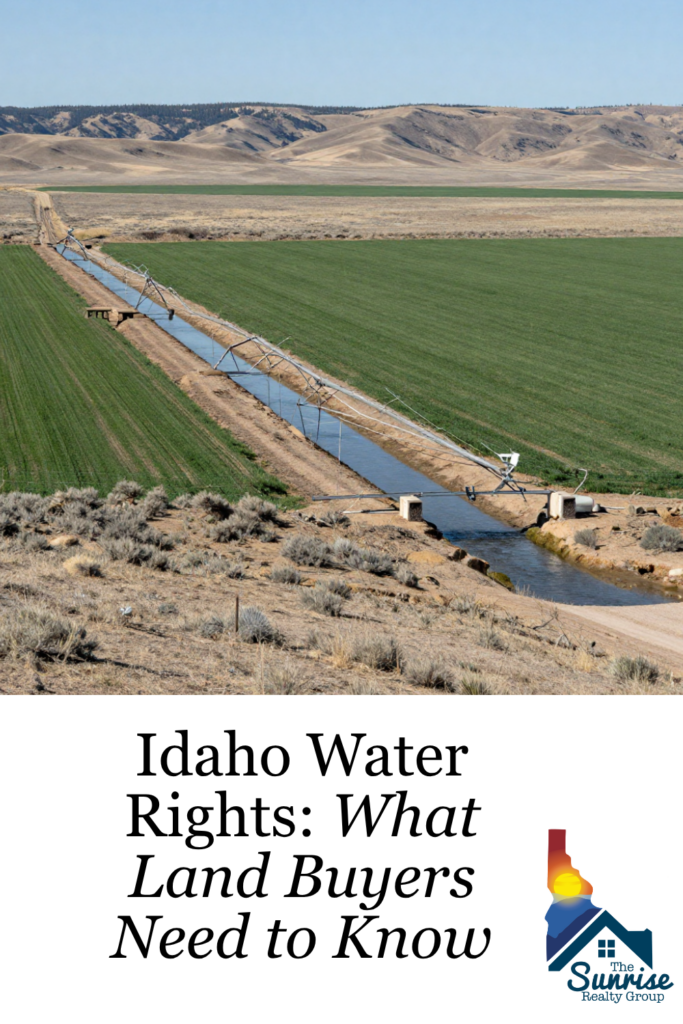
    Idaho water rights can have a major impact on what you can do with a piece of land, how the property is valued, and whether it supports your long-term plans.

    This is particularly important for buyers considering acreage, agricultural property, rural homesites, custom-home lots, or land intended for future development.

    One of the easiest mistakes to make is assuming that owning land automatically gives you the right to use whatever water is on, under, or next to it.

    Idaho doesn’t work that way.

    Water use is governed by a system of established rights, priority dates, authorized uses, diversion points, and other conditions. Depending on the property, you may also be dealing with a private well, irrigation company shares, canal water, a municipal system, or some combination of those.

    Understanding the basics of Idaho water rights before buying can help you identify questions that need to be answered before they become expensive problems.

    How Idaho Water Rights Work

    Idaho follows the prior appropriation doctrine, commonly summarized as:

    First in time, first in right.

    In simple terms, water rights with earlier priority dates generally have priority over later, or junior, rights when there isn’t enough water to satisfy everyone.

    That means two neighboring properties can have access to the same water source but have very different legal rights to use it.

    A water right can contain important elements such as:

    • Priority date
    • Source of water
    • Point of diversion
    • Place of use
    • Type or purpose of use
    • Diversion rate
    • Authorized volume
    • Period of use
    • Other conditions

    For a land buyer, simply being told that a property “has water rights” isn’t enough.

    You need to understand what rights exist and what those rights actually authorize.

    What Does “First in Time, First in Right” Mean?

    Priority becomes especially important when water supplies are limited.

    Generally, senior water rights are administered ahead of junior rights.

    If there isn’t enough water to satisfy all rights, junior users may have their water curtailed while senior rights continue to receive water according to the applicable administration of those rights.

    That’s why the priority date matters.

    An older water right can occupy a very different position from a newer one even when both properties otherwise look similar.

    However, don’t assume the priority date is simply the year the current owner began using the property.

    Priority is tied to how and when the particular water right was legally established.

    The official water-right record is where buyers should look for that information.

    Owning Land Doesn’t Automatically Create a Water Right

    Idaho water belongs to the public, and a landowner’s ability to divert and use water depends on the existence of an applicable water right, exemption, water-service arrangement, or other lawful authorization.

    That means buying a parcel next to a river doesn’t automatically give you permission to divert river water.

    Likewise, owning acreage doesn’t automatically mean you can drill a well and use unlimited groundwater for whatever purpose you choose.

    The property and the water authorization need to be evaluated separately.

    However, that does not mean water rights always stay separate when land is sold.

    Do Idaho Water Rights Transfer With the Property?

    This is an important distinction for buyers.

    Water rights that are appurtenant to real property generally pass with that property when it is conveyed unless the rights are expressly reserved or the transaction clearly provides otherwise.

    In other words, you shouldn’t assume either extreme:

    • Don’t assume that every mention of water automatically means a valid water right comes with the property.
    • But don’t assume that an existing appurtenant water right has to be separately listed and sold as an unrelated asset either.

    The transaction documents, chain of title, water-right records, and any reservations need to be reviewed together.

    New owners of established water rights should also make sure the Idaho Department of Water Resources has accurate ownership information.

    When water is important to your plans, confirm the rights as part of due diligence rather than relying solely on a listing description such as “irrigation available” or “water rights included.”

    Who Administers Idaho Water Rights?

    The Idaho Department of Water Resources, or IDWR, administers the state’s water-right system.

    IDWR maintains water-right records and handles matters involving areas such as:

    • Water-right permits
    • Licenses
    • Transfers
    • Ownership changes
    • Adjudication records
    • Water administration
    • Water-right research
    • Certain enforcement and curtailment matters

    Within established water districts, watermasters play an important role in administering water distribution according to recognized water rights and priority.

    For buyers, IDWR’s records are an important starting point when researching what water rights are associated with a property.

    Beneficial Use Is Central to Idaho Water Law

    A central concept in Idaho water law is beneficial use.

    Recognized beneficial uses can include:

    • Domestic use
    • Irrigation
    • Stockwater
    • Municipal use
    • Commercial or industrial uses
    • Hydropower
    • Aquaculture
    • Recreation
    • Fish and wildlife uses

    A water right isn’t simply permission to possess water indefinitely without regard to how it is used.

    The right is defined in part by the authorized beneficial use.

    This matters when buying land for a new purpose.

    For example, an irrigation water right should not automatically be treated as permission to use that water for a completely different purpose or at a different location.

    Changes to established elements of a water right may require approval.

    Can an Idaho Water Right Be Lost Through Nonuse?

    Potentially.

    Idaho law includes forfeiture provisions related to extended nonuse. A water right, or portion of one, may be subject to forfeiture after a continuous five-year period of nonuse.

    But “use it or lose it” is an oversimplification.

    There are statutory exceptions and circumstances that can affect whether nonuse results in forfeiture.

    For a buyer, the useful question isn’t simply:

    “Is there a water right on paper?”

    It’s also:

    “What is the current status and history of that right?”

    If an important water right hasn’t been used for years, additional investigation may be appropriate before relying on it for the property’s value or your future plans.

    Priority Dates Can Affect the Reliability of Water

    A water right’s priority date helps determine its standing relative to other rights during water shortages.

    Generally:

    • Older rights are more senior.
    • Newer rights are more junior.
    • Senior rights are administered before junior rights when available water is insufficient.

    This does not mean every junior right is inherently unusable or undesirable.

    It means buyers need to understand the right within the context of its source, location, priority, water district, and intended use.

    This can be especially important for agricultural land or property where irrigation is a significant part of its value.

    Surface Water and Groundwater Can Be Connected

    It’s easy to think of river water and groundwater as two completely separate systems.

    Hydrologically, they may not be.

    Idaho has rules for the conjunctive management of surface water and groundwater where the two sources are connected.

    In certain situations, groundwater pumping can affect surface-water users.

    That means a groundwater right isn’t necessarily insulated from water shortages or administration simply because the water comes from a well.

    Idaho’s conjunctive-management system allows priority administration to address injury to senior rights associated with connected water sources.

    For buyers, the key lesson is simple:

    A well does not automatically mean the water supply exists outside the larger water-right system.

    What About Domestic Wells?

    Private domestic wells deserve special attention because they are common on rural Idaho property.

    Certain qualifying domestic groundwater uses are exempt from the standard permit requirement.

    Current Idaho law defines qualifying domestic uses using specific limits involving the amount and purpose of water use. One common category is water for homes and related uses, such as irrigation of up to one-half acre, provided total use remains within the applicable statutory limit.

    That does not mean every well is unlimited or that every proposed use qualifies as exempt domestic use.

    Questions to investigate can include:

    • Does a well already exist?
    • Is there a well log?
    • What is the well depth?
    • What has the well historically supplied?
    • Does the proposed use fall within a domestic exemption?
    • Are you planning more irrigation than the exemption allows?
    • Will the property have more than one residence?
    • Does the development require a different water-right structure?
    • Are there subdivision, HOA, health-district, or other restrictions that affect the plan?

    If you’re buying acreage because you want a home, large irrigated landscape, shop, livestock, additional dwelling, or another significant use, don’t assume the words “private well” answer all of those questions.

    Irrigation Water May Work Differently

    Another important issue for Treasure Valley buyers is irrigation water.

    A property may receive irrigation water through an irrigation district, canal company, ditch company, or another delivery organization.

    In some cases, the individual landowner does not personally hold the underlying appropriation. Instead, the landowner may have shares or another right to receive water from the organization that holds the water right.

    That creates an important distinction between:

    having a water right and having a right to receive irrigation water.

    When evaluating irrigated property, buyers may need to determine:

    • Who supplies the irrigation water?
    • Are there shares associated with the property?
    • How are those shares conveyed?
    • What acreage is served?
    • What assessments or fees apply?
    • Where are the delivery points?
    • Are ditches or easements involved?
    • What is the typical delivery season?
    • Has the water historically been used on the parcel?

    “Has irrigation” is a starting point for investigation—not the end of it.

    Changing an Idaho Water Right May Require Approval

    A water right is defined by more than its quantity.

    Changes involving elements such as the:

    • Point of diversion
    • Place of use
    • Period of use
    • Nature or purpose of use

    may require an approved water-right transfer through IDWR.

    Transfers are reviewed in part to determine whether the proposed change would injure other water rights.

    This becomes especially important when land is changing uses.

    For example, agricultural property being converted to residential development may involve very different water needs and infrastructure than the original farming operation.

    You shouldn’t assume an existing agricultural water right can simply be moved, repurposed, or expanded however the new owner wants.

    Why Adjudication Matters

    A water-right adjudication is a court process used to determine existing water rights within a river basin.

    One of Idaho’s most significant examples is the Snake River Basin Adjudication, or SRBA.

    The SRBA resulted in a Final Unified Decree in 2014 and determined a vast number of water rights throughout the Snake River Basin, although certain qualifying de minimis domestic and stockwater uses were allowed to be deferred.

    For a buyer, an adjudicated water right can provide important information about legally determined elements of the right.

    IDWR also has water-right and adjudication search tools that can help identify records associated with particular rights.

    If the water situation is complicated, professional assistance may be needed to interpret what those records mean for a specific transaction or development plan.

    Why Idaho Water Rights Matter When Buying Land

    Water can affect far more than whether the grass stays green.

    Depending on the property, Idaho water rights can influence:

    • Agricultural use
    • Irrigated acreage
    • Livestock plans
    • Development feasibility
    • Well use
    • Property value
    • Site planning
    • Future land use
    • Financing considerations
    • Resale
    • The cost of developing the property

    A property can have beautiful acreage, good road access, favorable zoning, and an ideal home site while still presenting a major problem if the buyer’s intended water use isn’t supported.

    That’s why water needs to be part of land due diligence from the beginning.

    Questions to Ask Before Buying Idaho Land

    You don’t need to become a water-law expert before purchasing property.

    But you should know which questions need answers.

    Before relying on water for a property, consider asking:

    • What is the property’s water source?
    • Are there recorded water rights associated with the property?
    • Who owns those rights?
    • What are the water-right numbers?
    • What are the priority dates?
    • What uses are authorized?
    • What acreage or place of use is covered?
    • Where is the point of diversion?
    • Has the water historically been used?
    • Is irrigation supplied by a district or canal company instead?
    • Are shares involved?
    • Does a private well exist?
    • Is the proposed use within any applicable domestic exemption?
    • Would the intended development require a water-right change or new authorization?
    • Are there easements associated with irrigation infrastructure?
    • Does the water situation support what you actually intend to do with the property?

    The last question is the most important.

    A water arrangement that works perfectly for one buyer’s plans may be inadequate for another’s.

    Don’t Evaluate Water Separately From the Rest of the Property

    Water rights are only one part of deciding whether Idaho land is right for a particular project.

    They need to be evaluated alongside:

    • Zoning
    • Legal descriptions
    • Property boundaries
    • Easements
    • Access
    • Utilities
    • Septic feasibility
    • Topography
    • Building setbacks
    • Development requirements
    • Home design
    • Total project budget

    These issues overlap.

    Where water can legally be used may affect where and how land can be developed. Irrigation infrastructure may create easements across the property. A proposed subdivision can change the water analysis entirely.

    For someone planning to build, the right question isn’t simply:

    “Does this property have water?”

    It’s:

    “Does this property’s water situation support what I want to build and how I want to use the land?”

    Idaho Water Rights Should Be Verified Before You Buy

    Idaho water rights can be valuable, complicated, and easy to misunderstand.

    The most important points for land buyers are:

    • Land ownership alone does not create a right to use water.
    • Priority matters when water supplies are insufficient.
    • Existing appurtenant water rights may pass with property unless properly reserved or otherwise addressed.
    • The authorized use of a water right matters.
    • Changes to a right may require IDWR approval.
    • Domestic wells have rules and limitations.
    • Irrigation delivery rights and water-right ownership are not always the same thing.
    • Nonuse can create potential forfeiture issues.
    • Surface water and groundwater may be administered together.

    Most importantly, don’t rely on a listing description or an assumption when water is essential to your plans.

    Verify the records, understand the source, and make sure the available water fits the actual property use you’re considering.

    Buying or Building on Land in the Treasure Valley?

    If you’re considering land in Boise or elsewhere in the Treasure Valley, water is one part of a much larger due-diligence process.

    Sunrise Realty Group helps buyers look beyond acreage and listing photos to understand how the land, home design, builder, development requirements, and overall project fit together.

    Our 3-One Method brings those pieces into one connected process so buyers can make better-informed decisions before committing to a property that doesn’t support their plans.

    Because when you’re buying land to build a home, finding the right property is only the beginning.

    You also need to make sure the property can support the life you intend to build on it.

    Learn how Idaho water rights affect land purchases, wells, irrigation, priority dates, transfers, development, and building plans.
  • Construction Loan vs. Mortgage: What Idaho Home Buyers Need to Know

    Construction Loan vs. Mortgage: What Idaho Home Buyers Need to Know

    Understanding a construction loan vs. mortgage is one of the first financial steps to take if you’re planning to build a home in Idaho.

    If you’re buying an existing or already-completed new construction home, permanent mortgage financing may be fairly straightforward. But if you’re buying land and building a custom home, the financing process can look very different.

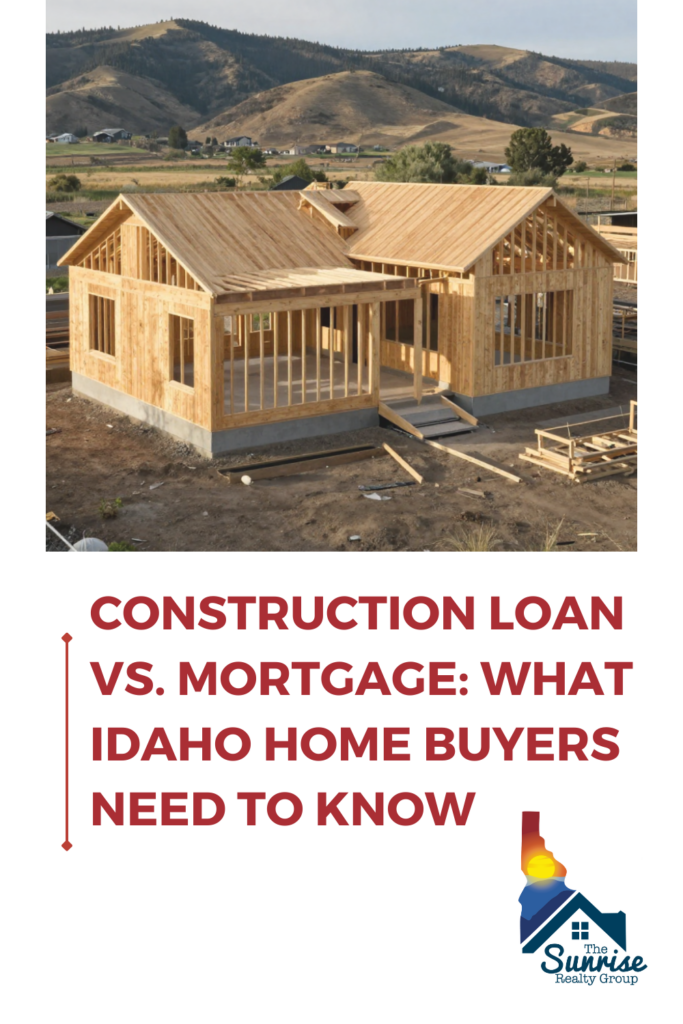
    Instead of paying for a finished property at closing, construction financing is designed to fund a project as the home is being built.

    That difference affects when money is released, what your lender needs to approve, how payments may work during construction, and what happens when the house is finished.

    Here’s what Idaho buyers should understand before choosing between a construction loan and a traditional mortgage.

    What Is a Traditional Mortgage?

    A traditional mortgage is long-term financing used to purchase a completed property.

    This can include:

    • An existing home
    • A completed new construction home
    • A home purchased directly from a builder after construction
    • Other finished residential property that meets the lender’s requirements

    With a typical mortgage, the lender funds the purchase at closing and the borrower begins making regular mortgage payments according to the loan terms.

    The lender generally examines factors such as:

    • Income
    • Credit
    • Debt-to-income ratio
    • Available funds
    • Property appraisal
    • Loan program requirements

    Because the house already exists, its current condition and value can be evaluated as part of the mortgage process.

    One important distinction: conventional mortgage is not simply another name for every traditional mortgage. Conventional loans are one category of permanent mortgage financing. Depending on eligibility and the property, buyers may also use government-backed or other mortgage programs.

    The main point is simple:

    A traditional mortgage generally finances a completed home. A construction loan finances the process of creating one.

    What Is a Construction Loan?

    A construction loan is financing designed to pay eligible costs associated with building a home.

    Depending on the lender, loan program, property, and transaction structure, construction financing may help cover costs such as:

    • Land or lot acquisition
    • Site preparation
    • Excavation
    • Utility installation
    • Construction materials
    • Builder labor
    • Engineering
    • Permits
    • Other approved construction expenses

    Unlike a traditional mortgage, the entire construction budget usually isn’t handed over at once.

    Funds are generally released in stages, often called draws, as construction progresses.

    For example, money may be released as the project reaches milestones involving the foundation, framing, mechanical systems, finishes, or other stages.

    The lender may require inspections or other documentation before approving subsequent draws.

    Construction Loan vs. Mortgage: What’s the Difference?

    Both types of financing can ultimately help you become a homeowner, although they serve different purposes.

    Traditional Mortgage

    A traditional mortgage generally:

    • Finances a completed home
    • Funds the purchase at closing
    • Uses the completed property as collateral
    • Has long-term repayment terms
    • Begins regular mortgage payments according to the loan agreement
    • Requires a standard property appraisal and borrower underwriting

    Construction Loan

    Construction financing generally:

    • Funds a home that hasn’t been completed yet
    • Releases funds in stages during construction
    • Requires lender review of the proposed project
    • May involve interest-only payments during the construction phase
    • Requires detailed plans, budgets, contracts, and other project information
    • May require lender approval of the builder
    • Must eventually be paid off or transition into permanent financing

    That last point is especially important.

    A construction loan is about building the house.

    A permanent mortgage is about financing the finished house over the long term.

    How Do Construction Loan Draws Work?

    The draw process is one of the biggest differences between construction financing and a regular mortgage.

    Instead of receiving the full construction amount upfront, funds are released as work is completed.

    A simplified example could look like:

    1. Site work and excavation
    2. Foundation
    3. Framing
    4. Roofing and exterior
    5. Plumbing, electrical, and HVAC
    6. Drywall and interior work
    7. Finishes
    8. Final completion

    The actual draw schedule depends on the lender, builder, contract, and project.

    Before releasing another portion of the loan, the lender may require confirmation that the previous stage has been satisfactorily completed.

    This gives the lender more oversight because the asset securing the loan is literally being created during the financing period.

    How Payments Work During Construction

    Construction financing may also handle borrower payments differently from a permanent mortgage.

    Depending on the loan terms, borrowers may make interest-only payments during the construction phase based on funds that have actually been advanced.

    As more funds are drawn, the outstanding construction balance can increase.

    The exact payment structure, rate, and requirements depend on the lender and loan program, so buyers should review these details carefully before closing.

    Don’t assume every construction loan works the same way.

    The Main Types of Construction Financing

    If you’re comparing a construction loan vs. mortgage, it helps to understand that there isn’t just one type of construction loan.

    Two common structures are construction-to-permanent financing and construction-only financing.

    Construction-to-Permanent Loan

    A construction-to-permanent loan combines the construction phase and permanent mortgage financing into a coordinated transaction.

    These are sometimes referred to as:

    • Construction-to-permanent loans
    • Construction conversion loans
    • Single-close construction loans
    • One-time-close construction loans

    Exact terminology varies by lender.

    During construction, funds are released according to the project’s draw process.

    After the home is completed and the lender’s requirements are satisfied, the financing transitions into the permanent mortgage according to the loan terms.

    The appeal is simplicity: the borrower can arrange the construction and permanent financing together rather than starting over with an entirely separate mortgage after the build.

    However, borrowers should still understand how the permanent rate, loan amount, qualification requirements, appraisal, and other terms are handled.

    Construction-Only Loan

    A construction-only loan finances the building phase without automatically becoming the final long-term mortgage.

    Once construction is complete, the construction financing must be paid off, commonly through permanent mortgage financing.

    That creates two separate financial stages:

    Construction financing → Permanent mortgage

    This structure may provide flexibility when choosing the permanent financing, but it can also mean another underwriting process, another closing, and additional closing expenses.

    The important question isn’t simply which one sounds easier.

    It’s which structure works for your project and financial situation.

    What About Renovation Loans?

    Renovation financing is related to construction financing, but it serves a different purpose.

    Rather than building an entirely new house, renovation loans may help finance the purchase or refinancing of an existing property along with qualifying improvements.

    That could include substantial remodeling, structural changes, additions, or other approved work.

    If your goal is to buy a fixer-upper rather than build on vacant land, ask your lender whether renovation financing makes more sense than a new-home construction loan.

    How Construction Loans Work When Building in Idaho

    The fundamentals of construction financing aren’t unique to Idaho, but the property and project still have to work within Idaho’s local development environment.

    Your lender will want enough information to determine whether both the borrower and proposed construction project meet its requirements.

    That can involve several areas.

    The Property

    The lender may need information about:

    • The lot
    • Ownership of the land
    • Existing land debt
    • Proposed home placement
    • Access
    • Utilities
    • Site conditions
    • Appraised value of the completed project

    If you already own the land, the lender will need to understand how that property as well as any existing equity fit into the financing structure.

    If you’re purchasing the lot as part of the construction transaction, the process may work differently.

    The Builder

    Construction lenders commonly have requirements for the builder participating in the project.

    A lender may review items such as:

    • Contractor information
    • Experience
    • Insurance
    • Financial information
    • Construction history
    • Project documentation
    • Contract terms

    In Idaho, buyers should also verify the contractor’s applicable Idaho contractor registration.

    Lender approval and state contractor registration are separate issues. A contractor meeting state requirements does not automatically mean every construction lender will approve that builder for its loan program.

    Plans and Specifications

    Before approving construction financing, the lender generally needs to understand what is actually being built.

    Documentation may include:

    • Building plans
    • Site plan
    • Specifications
    • Engineering
    • Construction contract
    • Detailed budget
    • Allowances
    • Proposed schedule

    A vague estimate for “a house around this size” isn’t enough to establish how much the project will cost or what the completed property should be worth.

    The Appraisal

    Appraising a proposed home is different from appraising a completed house.

    The appraiser may evaluate the plans, specifications, site, and other project information to develop an opinion of what the property is expected to be worth when completed.

    This matters because a home can cost a certain amount to build without necessarily appraising for exactly that amount.

    For buyers, that means construction cost and completed market value need to stay connected throughout the planning process.

    Why Construction Financing Requires More Project Information

    A traditional mortgage finances an asset that already exists.

    With construction financing, many important pieces are still in the future.

    The lender is evaluating not only the borrower but also whether the proposed home can realistically be completed.

    Possible issues can include:

    • Construction delays
    • Design changes
    • Cost overruns
    • Site problems
    • Material changes
    • Contractor issues
    • Appraisal shortfalls
    • Permit delays
    • Unexpected property conditions

    That’s why construction financing commonly involves more documentation and project oversight than purchasing a completed home.

    It also explains why buyers should involve their lender early rather than waiting until plans and builder contracts are already finalized.

    Construction-to-Permanent vs. Two-Closing Financing

    For someone building a home, the long-term financing path often falls into one of two general categories.

    Single-Closing Structure

    With a qualifying construction-to-permanent structure:

    1. Construction and permanent financing are arranged together.
    2. Construction funds are advanced during the build.
    3. The home is completed.
    4. The construction phase moves into permanent mortgage financing according to the loan terms.

    The main appeal is having a coordinated financing process from construction through long-term ownership.

    Two-Closing Structure

    With separate construction and permanent financing:

    1. You close on financing for construction.
    2. The home is built.
    3. You obtain permanent mortgage financing.
    4. The permanent loan pays off the construction financing.

    Because these are separate transactions, buyers should understand the costs and qualification requirements for each stage.

    Neither structure is automatically better for everyone.

    Compare the complete financing picture rather than choosing based on one feature.

    Do You Need a Construction Loan for Every New Home?

    No.

    This is an important distinction for buyers shopping for new construction.

    If a builder owns the land, finances construction, completes the home, and then sells the finished property to you, you may purchase the completed home using ordinary permanent mortgage financing.

    That’s very different from a custom-build situation where you own or purchase the land and finance construction yourself.

    So don’t assume:

    New construction = construction loan.

    The financing depends on how ownership, construction, and the eventual purchase are structured.

    Which Financing Option Makes Sense for You?

    The right answer depends on what you’re actually buying or building.

    A Traditional Mortgage May Make Sense If:

    • You’re buying an existing home
    • You’re purchasing a completed new construction home
    • The builder is financing construction and selling you the finished property
    • You don’t need to personally fund the construction process

    Construction Financing May Make Sense If:

    • You’re buying land and financing a custom build
    • You already own land and are ready to build
    • You’re responsible for financing construction
    • Your project requires staged funding as work progresses

    The lender should help determine which loan products you qualify for and which structures are available for your particular project.

    Your real estate agent can help you evaluate a different part of the equation: whether the land, location, proposed home, and purchase structure make sense together.

    Don’t Design the Entire House Before Understanding the Financing

    One of the easiest mistakes to make is falling in love with a design before establishing what the total project can support.

    That can create problems such as:

    A better process is to bring the major pieces together early.

    That generally means understanding:

    These decisions affect one another.

    Treating financing, land, design, and construction as completely separate decisions can create problems later.

    Construction Loan vs. Mortgage: Start With the Bigger Picture

    The biggest difference between a construction loan and a mortgage is what each one is financing.

    A mortgage typically finances a completed home.

    A construction loan finances the process of building one.

    For Idaho buyers planning a custom home, however, the financing decision isn’t just about selecting a loan product.

    The land has to support the home.

    The design has to fit the budget.

    The builder has to fit the project.

    And the financing has to work with all three.

    Sunrise Realty Group helps Treasure Valley buyers approach those pieces as one connected process instead of trying to solve each part independently.

    Our 3-One Method brings together the land, home design, and builder so buyers can make better-informed decisions before committing to a project that doesn’t fit their goals.

    If you’re thinking about building a home in Boise or elsewhere in the Treasure Valley, start with the complete picture.

    The loan is one piece of it—but all the pieces need to work together.

    Compare a construction loan vs. mortgage and learn how each works for land, custom homes, new construction, and financing in Idaho.
  • What Are Idaho Closing Costs?

    What Are Idaho Closing Costs?

    What Are Idaho Closing Costs?

    If you’re planning to buy a home in Idaho, you’ve probably heard the term closing costs. For many first-time buyers, these expenses can come as a surprise because they are separate from the home’s purchase price and your down payment. Understanding what closing costs are before you begin shopping for a home can help you prepare financially and make the buying process much less stressful.

    What Are Closing Costs?

    Closing costs are the collection of fees and expenses that are paid when the purchase of a home is finalized. They cover the services and administrative work required to transfer ownership from the seller to the buyer and complete the mortgage process.

    Rather than being a single fee, closing costs include several different charges that are paid to various professionals and organizations involved in the transaction.

    What Do Closing Costs Pay For?

    Depending on your purchase, closing costs may include expenses such as:

    • Loan processing by your lender
    • Property appraisal
    • Title search and title insurance
    • Escrow services
    • Recording the new ownership with the county
    • Homeowners insurance
    • Property taxes and prepaid interest
    • Homeowners association fees, if applicable

    Each of these plays an important role in ensuring your home purchase is completed legally, accurately, and with as few surprises as possible.

    Why Do Closing Costs Matter?

    Many buyers spend months or even years saving for a down payment but don’t realize they will also need to account for closing costs. Planning for these expenses early can help prevent delays and make the closing process much smoother.

    Knowing about closing costs also allows you to have informed conversations with your lender and real estate agent so you understand exactly what you’re paying for and why.

    Can Closing Costs Be Negotiated?

    In many cases, yes.

    Depending on the terms of the purchase agreement and current market conditions, buyers and sellers may negotiate who pays for certain expenses. A seller may agree to contribute toward some closing costs as part of the negotiation, or a lender may offer credits that help reduce the amount you pay at closing.

    Every transaction is different, which is why having experienced professionals representing you can make a significant difference.

    Are Closing Costs the Same as a Down Payment?

    No. These are two separate parts of purchasing a home.

    A down payment is the portion of the home’s purchase price that you contribute toward the purchase. Closing costs, on the other hand, pay for the services required to complete the transaction and finalize your loan.

    Because they serve different purposes, it’s important to plan for both when preparing to buy a home.

    When Will I Know What My Closing Costs Are?

    Your lender will provide documents throughout the loan process that outline the expected costs associated with your purchase. As your closing date approaches, you’ll receive a detailed breakdown showing each expense and explaining what it covers.

    Reviewing these documents carefully gives you the opportunity to ask questions and fully understand your financial responsibilities before signing the final paperwork.

    How Can I Prepare for Closing Costs?

    The best way to prepare is to discuss them with your lender and real estate agent as early as possible. They can help you understand which costs are typical for your transaction, explain the purpose of each fee, and identify any opportunities to negotiate.

    Planning ahead allows you to focus on the excitement of buying a home rather than worrying about unexpected expenses during the final stages of the process.

    Final Thoughts

    Closing costs are a normal part of buying a home in Idaho and represent the work that goes into making your purchase secure, legal, and complete. While they can seem overwhelming at first, understanding what they are and why they exist makes the home-buying process much easier to navigate.

    Whether you’re purchasing your first home or your next home, having knowledgeable professionals by your side can help ensure you know what to expect every step of the way. With the right guidance and preparation, you’ll be ready to move into your new home with confidence.

  • Do I Really Need a Real Estate Agent to Buy a Home in Idaho?

    Do I Really Need a Real Estate Agent to Buy a Home in Idaho?

    The short answer is no—you are not legally required to hire a real estate agent to buy a home in Idaho. Many people successfully purchase homes on their own every year. That said, having the right professional in your corner can make the process significantly smoother and help you avoid costly mistakes.

    Buying a home is one of the largest financial decisions most people will ever make. Beyond finding a property you love, there are contracts, inspections, financing deadlines, negotiations, title work, disclosures, and closing requirements that all need to be managed carefully. Missing a single detail can create unnecessary stress or expenses.

    A good real estate agent acts as your guide and advocate throughout the entire process. They can help you understand current market conditions, determine a competitive offer price, negotiate repairs or concessions, and coordinate with lenders, title companies, inspectors, and other professionals involved in the transaction.

    In Idaho, local knowledge matters. Every community has its own nuances when it comes to growth, development, zoning, schools, utilities, and future plans. Whether you’re buying in Boise, Meridian, Eagle, Nampa, Caldwell, or a more rural area, having someone who understands the local market can provide valuable insight that online listings simply cannot.

    This is especially true for buyers interested in land or new construction. Understanding things like well and septic requirements, CCRs, building restrictions, impact fees, and permitting processes can be overwhelming without experienced guidance.

    Ultimately, you don’t need a real estate agent to buy a home—but for many buyers, having a trusted professional by their side provides peace of mind, saves time, and helps them make more confident decisions throughout the journey.

  • Living the Idaho Dream: 7 Reasons to Build Instead of Buy in the Treasure Valley

    Why build instead of buy? For many, the Idaho dream means building a home in the Treasure Valley that truly reflects their lifestyle.

    Where Boise’s foothills meet farmland and fast-growing communities, more buyers are opting to build rather than compete for resale homes. Building offers more control over layout, finishes, energy efficiency, and functionality.

    Resale homes can still be a great fit, but they often come with tradeoffs. The layout may not match how your family lives now. The systems may be a little older. The updates may be half-finished, or the right homes may not be available in the locations you actually want.

    For buyers relocating to the Treasure Valley, moving toward Star or Kuna, upgrading from a first home, or planning their forever home, building can offer a cleaner path. You are not just picking from what happens to be listed. You are starting with the home, lot, layout, and lifestyle you want to build around.

    Here are seven reasons buyers choose to build instead of buy in the Treasure Valley.

    7 Reasons to Build Instead of Buy in the Treasure Valley

    1. You Get the Home You Actually Want

    Buyers who build can start with what they truly want, rather than settling for an imperfect fit.

    Resale homes force compromises. The kitchen may be dated, the garage too small, the layout wrong, or the finishes and storage inadequate for daily life.

    Building starts with your lifestyle and home plans.

    Do you want a modern farmhouse with vaulted ceilings? An oversized garage or RV bay? What about a larger kitchen island? Open-concept floor plans? A semi-custom home with upgraded finishes? A multi-generational suite? A dedicated office?

    New construction gives buyers more time to make those decisions before the home is built, rather than paying later to remodel someone else’s old floor plan.

    Custom and semi-custom builders in the Treasure Valley offer a variety of design options, helping buyers find a home that feels intentional from the start.

    Instead of adapting to a house, shape it around your life.

    2. New Builds Are Often More Energy Efficient

    Idaho experiences all four seasons, and older homes are not always built for how modern families use energy today. Even well-loved homes can come with older windows, aging HVAC systems, insufficient insulation, outdated appliances, or drafty doors.

    New homes in Idaho meet modern code requirements and industry standards, reducing monthly utility costs and maintenance expenses.

    Today’s new homes may include:

    • High-performance windows
    • Better insulation
    • Tighter building envelopes
    • Efficient appliances
    • Smart thermostats
    • Improved ventilation systems
    • More efficient heating and cooling equipment

    Energy-efficient homes can lower the cost of ownership over time by reducing utility bills and maintenance needs. They can also make the home more comfortable during hot summers, cold winters, and the shoulder seasons when Idaho weather changes its mind every few hours.

    Consider energy performance alongside the sale price—ongoing costs matter after move-in.

    3. You Can Avoid Bidding Wars and Resale Pressure

    In Boise, Meridian, Eagle, Kuna, Star, Nampa, and Middleton, resale homes can sell immediately. Buyers feel rushed to tour, offer, and decide.

    This pressure can be especially stressful for first-time buyers or those relocating.

    But if you want to build before you buy? Well, when you build a home, the process looks different.

    You are not rushing from one showing to the next. You are not competing against multiple offers on the same weekend. You are not guessing what repairs may show up after inspection. You are not trying to win a house that was never quite right in the first place.

    You compare options like buying land, designs, builders, timelines, and pricing with greater clarity.

    Building still requires planning, patience, and guidance, but for many, it feels more strategic than competing for limited resale inventory.

    4. New Construction Means Fewer Repairs and Surprises

    Older Treasure Valley homes hide costs—roof problems, bad HVAC, outdated plumbing, old insulation, poor windows, worn floors, and foundation issues often go unseen.

    A new home gives you a fresh start.

    With a new home build, major systems and materials are new from the beginning. That may include:

    • New roof
    • New HVAC system
    • New water heater
    • New framing and exterior materials
    • New finishes and fixtures
    • New appliances
    • Updated electrical and plumbing systems

    Many builders also offer warranties that cover workmanship, systems, or structural components for a set period. Warranty terms vary by builder, so buyers should always review the details carefully, but the added protection can be a major benefit.

    Buyers wanting to avoid immediate, expensive repairs may find peace of mind with new construction.

    5. You Get Access to New Home Communities

    Treasure Valley’s fastest-growing communities offer new neighborhoods with parks, schools, trails, shopping, open space, and strong community connections. Meridian, Kuna, Star, Eagle, Middleton, and Nampa attract these buyers.

    New home communities may include:

    • Walking paths
    • Green space
    • Playgrounds
    • Community pools
    • Planned commercial areas
    • Well-designed neighborhood layouts
    • Access to nearby schools and amenities

    When you build, you may have more control over lot features like orientation, views, yard size, and proximity to amenities.

    Existing homes can offer established neighborhoods and mature landscaping, which many buyers love. But new communities are often designed around how people live now, with greater attention to open layouts, flexible spaces, neighborhood amenities, and connections to surrounding growth.

    For many buyers, that combination is hard to ignore.

    6. Building Lets You Plan for the Future

    Homes now do more than ever.

    Remote work, home gyms, flex rooms, big garages, outdoor living, and tech needs redefine what buyers expect from a home. Old floor plans may not fit current needs.

    Building lets buyers proactively plan for needs from the start, not as an afterthought.

    That might include:

    • A dedicated home office
    • Fiber internet wiring
    • An oversized garage or RV bay
    • A large covered patio
    • High ceilings
    • Smart home features
    • A multi-generational layout
    • Energy-efficient upgrades
    • More storage
    • Flexible rooms that can change over time

    Updating an older home can be expensive—walls, wiring, garage space, positioning, and storage may all need improvement.

    A new build allows you to plan those features before construction starts.

    Building allows for both current and future lifestyle needs—not just today’s demands.

    7. Building Can Support Long-Term Value

    New construction can be a strong long-term choice in Idaho when well-designed, well-placed, and built with quality.

    The Treasure Valley attracts buyers for lifestyle, recreation, business growth, and community. Modern homes stay attractive to future buyers as demand continues.

    New construction may support long-term value through:

    • Updated layouts
    • Newer materials
    • Lower maintenance needs
    • Better energy performance
    • Modern finishes
    • Stronger resale flexibility
    • Better alignment with current buyer preferences

    A well-planned new home offers strong value by aligning with lifestyle and real estate trends.

    That is why guidance matters. The right plan can help buyers avoid overbuilding, underplanning, or choosing a property that does not align with their goals.

    Building in the Treasure Valley: What to Expect

    Sunrise Realty Group’s design-first building approach, paired with MC Design House, helps guide clients through the home-building process with more clarity from the start.

    Step 1: Secure Land

    Bring your own land or let the team find the right lot in the Treasure Valley. Choose one that fits your budget, lifestyle, design, and building needs.

    Step 2: Create Your Custom Home Design

    After finding the land or direction, start the design. Compare home plans, layouts, finishes, priorities, and budget.

    Step 3: Connect With a Vetted Builder

    Sunrise Realty Group connects you with vetted builders who match your project, timeline, and customization needs.

    Step 4: Build, Customize, and Move In

    From there, buyers can watch the home come together step by step. Throughout the construction process, the goal is to keep communication clear, expectations aligned, and decisions connected from land to design to finished home.

    Final Thoughts: Building Is the Idaho Dream for Many Buyers

    Living in Idaho offers a little slice of Heaven: big skies, strong communities, outdoor recreation, and room to create something personal. For many families, building is the clearest path to a home that fits their life now and in the years ahead.

    Building can offer:

    • Personalization
    • Energy efficiency
    • Long-term savings
    • Fewer repairs
    • Modern layouts
    • Better planning for future needs
    • Strong resale appeal

    Whether you are creating your forever home, upgrading from your first home, relocating to the Treasure Valley, or designing for future generations, building can be a smart way to make the Idaho dream feel real.

    If you are ready to explore building and want support at every step, Sunrise Realty Group can help guide you from land and design to builder coordination and keys.

    Explore why more Idaho buyers choose to build instead of buy in the Treasure Valley, the benefits of new construction, and long-term value.

  • How to Analyze Zoning Before You Buy Land: A Practical Due Diligence Guide

    Zoning Series — Part 6

    Analyze zoning before buying land in Idaho. A parcel may appear perfect online, but still have limits on what, where, or whether you can build.

    Zoning mistakes are not obvious at first. They usually do not appear in listing photos or a quick conversation with a seller, agent, or neighbor.

    A property may have the right acreage, view, location, and nearby homes. Then deeper questions arise.

    Can you actually build the type of structure you want there? Is the use allowed? Are there setbacks, overlays, easements, or access issues? Would the project require a variance, a conditional use permit, subdivision approval, or a public hearing?

    That is why zoning due diligence is necessary before spending money on plans, surveys, engineering, or design. Zoning is not the only factor in whether land is buildable, but buyers should check it first before committing.

    This guide walks through a practical process for buyers, builders, and investors who want to understand the rules before buying land or designing a project.

    Why You Should Analyze Zoning Before You Buy Land

    Land is marketed in broad, optimistic language like “great building site,” “development potential,” or “ideal for a custom home.”

    Those phrases are not proof.

    They may be accurate, but still must be checked against the property’s zoning, jurisdiction, land-use rules, title, access, utilities, and approvals.

    The goal is not to master zoning overnight but to catch obvious issues early and know when to seek a professional before a small assumption becomes expensive.

    For buyers in Boise, the Treasure Valley, or Idaho, analyze zoning early. Delaying until after closing, design meetings, or builder estimates can turn a fixable issue into a costly problem.

    Step 1: Confirm the Exact Zoning Classification

    Start with the official zoning designation.

    Do not rely on the listing, the seller’s memory, or appearances. Zoning can change from parcel to parcel. One property may have a nonconforming use, a grandfathered structure, or special approval not applicable next door.

    In the beginning, start by confirming three things:

    • The zoning district name
    • The zoning code section
    • The jurisdiction that controls the property

    That last point matters. A property may be in a city, county, or an area where multiple agencies have authority. In the Treasure Valley, this is especially confusing when it comes to limits, impact areas, rural parcels, and properties near growing communities.

    Before you move further, make sure you know whose rules you are reading.

    Step 2: Read the Use Table Before Anything Else

    Once you know the zoning, go straight to the use table.

    Buyers often skip straight to setbacks, building size, or design, but none of them matter if the intended use is not allowed.

    Look for whether your intended use is:

    • Allowed by right
    • Allowed with conditions
    • Allowed only through a special process
    • Not allowed at all

    Check if you can build a single-family home, add an ADU, build a shop, run a home business, add more dwellings, or use it for agriculture, rental, commercial, or mixed use.

    If the use is not explicitly allowed, pause the purchase conversation until you better understand the path forward.

    Sometimes the answer is simple, but other times, it requires a conversation with the planning department or indicates the property does not fit the plan.

    Step 3: Check Density and Lot Requirements

    Acreage alone does not decide what can be built.

    This is a common misunderstanding among buyers. A large parcel may still be limited in the number of homes, units, or lots it can support. Density is governed by zoning, subdivision rules, access, infrastructure, and sometimes health district requirements.

    Check for:

    • Minimum lot size
    • Minimum lot width or frontage
    • Maximum number of dwellings
    • Allowed accessory dwelling units
    • Subdivision rules
    • Lot coverage limits
    • Access or road frontage requirements

    This step is especially important if you are thinking about future development.

    For example, a buyer may see a five-acre parcel and assume it can be split into several lots. Maybe. It depends on zoning, subdivision rules, access, utilities, and approvals.

    “Big enough” is not the same as “allowed.”

    Step 4: Find the Buildable Envelope

    After confirming the use and density rules, figure out where a structure could physically go.

    This is called the buildable envelope. It is the part of the property where construction may be allowed, subject to setbacks and restrictions.

    Review:

    • Front setbacks
    • Side setbacks
    • Rear setbacks
    • Street-side setbacks on corner lots
    • Buffers from other zones or uses
    • Easements
    • Floodplain areas
    • Drainage areas
    • Environmental buffers
    • Irrigation features
    • Access requirements

    A lot that looked wide open may feel much smaller after these checks.

    A property may allow a home, but the buildable area might be limited by setbacks, easements, slopes, flood boundaries, or road access. The best spot may not be legal or practical to build.

    Before designing anything, get a realistic sense of where the structure could sit.

    Step 5: Verify Height and Massing Limits

    Height limits can cause problems late in design if unchecked early.

    This matters for two-story homes, sloped lots, bonus rooms, garages with living space, view properties, and custom designs with taller rooflines.

    Confirm:

    • Maximum building height
    • How height is measured
    • Whether the slope affects the calculation
    • Roof pitch rules
    • Architectural projection limits
    • Accessory structure height limits
    • Any special hillside or design overlay rules

    The phrase “maximum height” sounds simple, but different jurisdictions may measure height differently. Some measure from natural grade. Some use the average grade. Some have special rules for sloped lots or roof types.

    Key takeaway: Check how height is measured to prevent costly design revisions later.

    Step 6: Look for Overlay Zones

    Overlay zones are extra rules added to the base zoning district.

    A property may have standard zoning and still fall under an overlay that changes what can happen.

    Common examples include:

    • Floodplain or floodway areas
    • Hillside or steep-slope overlays
    • Wildfire or fire hazard areas
    • Wetlands or riparian buffers
    • Historic districts
    • Design review areas
    • Airport or noise overlays
    • Sensitive lands

    Overlay zones may not block a project, but can add reviews, reports, engineering, limits, or extra approvals.

    Takeaway: Overlay zones can increase project costs and approval steps, so investigate overlays early.

    A buyer looking at a beautiful hillside lot, river-adjacent parcel, or rural property near open land should be especially careful here. The setting may be exactly what makes the property attractive, but it may also be what triggers extra review.

    Step 7: Review Easements, Plat Notes, and Title Issues

    Zoning shows public rules, not every restriction.

    That is why titles and recorded documents matter.

    Before assuming where you can build, review:

    • The recorded plat
    • Title report
    • Utility easements
    • Drainage easements
    • Access easements
    • Irrigation easements
    • Shared driveway agreements
    • Private road agreements
    • Subdivision notes
    • Survey information, if available

    An easement can block construction even when zoning allows. A plat note may create limits that are easy to miss. Shared road or access issues may affect financing, permitting, or development.

    Takeaway: Professional reviews of title, surveys, and easements help avoid hidden pitfalls.

    Step 8: Check HOA and Private Restrictions

    If in a subdivision or private development, zoning is only part of the story.

    Review the CC&Rs, architectural rules, and design review process before assuming your plan will be allowed.

    An HOA or private review board may control:

    • Exterior materials
    • Roof pitch
    • Fence style
    • Detached shops
    • ADUs
    • Short-term rentals
    • Landscaping
    • Driveway design
    • Outbuilding placement
    • Architectural style

    Private restrictions can be stricter than zoning. They cannot override public rules, but can add approval layers.

    Key takeaway: HOA approval is not guaranteed by public permits; always check private restrictions.

    Step 9: Confirm Utilities and Infrastructure

    Zoning may allow a structure, but infrastructure still dictates what is realistic.

    Before buying land, confirm the practical pieces:

    • Water availability
    • Sewer connection or septic feasibility
    • Power access
    • Gas availability, if needed
    • Road access
    • Fire access
    • Emergency vehicle access
    • Drainage requirements
    • Irrigation considerations
    • Internet or communication service, if important

    Some seem basic until missing.

    A parcel may look affordable because the expensive work has not been done yet. Extending utilities, improving a road, drilling a well, adding a septic system, addressing drainage, or meeting fire access requirements can change the property’s real cost.

    Final takeaway: Combine zoning and infrastructure checks to fully understand project feasibility before buying.

    Step 10: Understand the Approval Path

    The final step is to understand the level of risk built into the approval process.

    Some projects are allowed by right. That usually means the use is permitted if the project meets the applicable standards.

    Other projects require additional review. That may include administrative approval, a conditional use permit, a variance, a subdivision application, a design review, or a public hearing.

    Ask:

    • Does the project require a variance?
    • Is a conditional use permit needed?
    • Will there be a public hearing?
    • Can neighbors appeal?
    • Is subdivision approval required?
    • Is the approval administrative or discretionary?
    • What happens if the request is denied?

    This is where timeline and outcome risk come in.

    A property that only works if several approvals go your way is not the same as a property where the intended use is already allowed. That difference should affect how you evaluate price, timing, financing, and whether the deal makes sense.

    Red Flags That Should Make Buyers Pause

    Not every red flag means “walk away.” Some simply mean “slow down and verify.”

    Be careful when you see:

    • The intended use is not clearly allowed.
    • The plan depends on future rezoning.
    • The seller is relying on what nearby properties have done.
    • The project needs a variance for basic design elements.
    • The listing does not mention overlays.
    • Subdivision potential has not been confirmed.
    • Access is unclear
    • Utilities are assumed but not verified.
    • The buildable area has not been mapped.
    • The phrase “should be fine” is doing too much work.

    That last one matters.

    When land is involved, “probably fine” is not enough. Get the answer in writing from the correct source or bring in the right professional before moving forward.

    When to Bring in Professional Help

    A simple residential lot may only require basic research and a few calls. A more complicated property deserves a deeper review.

    Consider bringing in professional help when:

    • Buying land for development
    • Building on a sloped or constrained lot
    • Planning multiple dwellings
    • Pursuing subdivision
    • Working around floodplain, hillside, or wildfire concerns
    • Relying on a variance or conditional use permit
    • Buying rural acreage
    • Designing a custom home
    • Adding an ADU, shop, or accessory structure
    • Dealing with private roads or shared access

    Depending on the property, that help may come from a real estate professional, land-use planner, surveyor, architect, engineer, builder, attorney, title company, or local planning department.

    Early guidance is almost always cheaper than redesigning later.

    The Big Picture: Zoning Is One Layer of Buildability

    Zoning analysis is not a single checkbox. It is a sequence.

    First, confirm the property’s zoning classification. Then verify the allowed use. From there, check density, setbacks, overlays, easements, utilities, private restrictions, and approval risk.

    That order matters.

    A property can be beautiful yet difficult to build on. It can have acreage and still be limited. It can be zoned residential and still have constraints that affect the design, budget, or timeline.

    The point is not to scare buyers away from land. It is to help them ask sharper questions before they are financially committed.

    Buying Land in Idaho? Start With the Right Questions

    If you are buying land in Boise, the Treasure Valley, or elsewhere in Idaho, zoning should be part of your early due diligence.

    The right property is not just the one that looks good online. It is the one where your intended use, budget, design, timeline, and approval path can work together in the real world.

    Sunrise Realty Group helps buyers think through those questions before they get too far into a purchase or build plan. From land search and zoning conversations to builder coordination and local real estate guidance, the goal is simple: fewer assumptions, fewer surprises, and a clearer path forward.

    Learn how to analyze zoning before you buy land in Idaho, including allowed uses, setbacks, easements, utilities, and approval risks.
  • How a Construction Loan to Permanent Mortgage Conversion Works

    If you are building a custom home or buying a new construction property, one of the most important financing questions is how a construction loan-to-permanent mortgage conversion actually works.

    Many buyers assume the process is automatic. Sometimes it is. Sometimes it is not. The answer depends on how the loan was structured before construction began.

    This is where confusion can get expensive. A buyer may understand the floor plan, builder contract, and construction timeline, but still miss the financing structure that controls what happens when the home is finished. That final step can affect your closing costs, interest rate, underwriting, appraisal, cash needed to close, and move-in timeline.

    Here is how the process works in plain English.

    What Construction Loan to Permanent Mortgage Really Means

    A construction loan is short-term financing used while a home is being built. The money is not usually handed over all at once. Instead, funds are released in stages as work is completed.

    During construction, payments are often interest-only. That means you are paying interest on the funds that have been drawn, not necessarily paying principal and interest the way you would on a normal mortgage.

    Once the home is complete and legally ready to occupy, the construction financing has to be resolved. It either converts into long-term mortgage financing or gets paid off by a new mortgage.

    That long-term mortgage is often called the permanent mortgage or the end loan.

    The structure matters because it tells you whether you have one or two closings, whether you need to qualify again, and how much risk you carry while the home is being built.

    The Two Main Construction Loan Structures

    Most buyers will encounter one of two loan types: a construction-to-permanent loan or a construction-only loan.

    A construction-to-permanent loan is often called a one-time close loan. With this structure, the construction loan and permanent mortgage are approved together at the beginning. You close once, construction begins, and the loan later converts into a permanent mortgage after the home is complete.

    That setup can feel cleaner because the permanent financing is already part of the plan. You are not starting over with a brand-new mortgage application after construction.

    A construction-only loan works differently. It only covers the build phase. When the home is done, that loan has to be paid off. Most buyers do that by getting a new mortgage. That second loan is the end loan.

    This can grant flexibility, but it also adds risk. If rates go up, your income changes, your credit shifts, or the final value does not come in where expected, the second closing may become more stressful than planned.

    Before Construction Starts

    The construction loan-to-permanent mortgage path begins before anyone breaks ground.

    At the start, the lender is looking at more than your income and credit. They also want to understand the project itself. That usually means reviewing the building plans, construction budget, builder contract, timeline, land value, and estimated completed value.

    This is one reason construction financing feels different from buying an existing home. With a resale home, the lender can review a property that already exists. With a build, the lender is approving a home that is still on paper.

    That makes the early planning stage more important. If the budget is too thin, the builder contract is vague, or the land has unresolved approval issues, the financing can become harder to manage later.

    Buyers should also pay attention to how cost overruns will be handled. Many lenders do not simply increase the loan because materials, labor, or site work came in higher than expected. In many cases, the borrower has to cover the difference.

    During Construction: Draws and Interest-Only Payments

    Once the construction loan closes, funds are released through draws.

    A draw is a staged release of money tied to construction progress. Common milestones may include site work, foundation, framing, dry-in, rough plumbing and electrical, drywall, finishes, and completion.

    Before a draw is released, the lender usually wants verification that the work has been completed. That may involve a draw inspection, photos, lien documentation, invoices, or other paperwork, depending on the lender and project.

    This protects the lender because the property is the collateral. It also protects the borrower from having to pay in advance for work that has not been done.

    During this phase, the monthly payment can change. Early in the build, only a small portion of the loan may have been drawn, so that the interest-only payment may be lower. As construction continues and more funds are released, the balance increases, possibly resulting in to a higher payment.

    That can catch buyers off guard if they are also paying rent, carrying another mortgage, or managing storage and moving costs during the build.

    What Has to Happen Before the Loan Converts

    A construction loan-to-permanent mortgage conversion does not usually happen just because the builder says the house is done.

    The lender needs proof that the project is complete enough to support permanent financing. That usually means the home has passed final inspections, the local jurisdiction has issued a Certificate of Occupancy or equivalent approval, and the property is legally habitable.

    The lender may also require a final appraisal update or completion report. This confirms that the finished home is consistent with the plans and assumptions used earlier in the loan process.

    Lien waivers may also matter. The lender wants to know that contractors, subcontractors, and suppliers have been paid properly so the permanent mortgage is not at risk from construction-related lien claims.

    This is the point where paperwork, inspections, title, appraisal, and local approval all come together. If one piece is missing, the conversion or end-loan closing can be delayed.

    Path 1: One-Time Close Conversion

    With a one-time close loan, the process is usually more predictable.

    The borrower closes before construction begins. The construction phase is temporary. Once the home is complete and the lender has the required documentation, the loan converts into its permanent structure.

    That does not mean nothing can change. Some loan terms may still be modified before conversion, depending on the program and lender guidelines. The interest rate, loan amount, loan term, or amortization type may be reviewed or adjusted in certain situations.

    Still, the main advantage is that the buyer is not usually starting from zero at the end of construction. The permanent mortgage was already part of the earliest structure.

    For buyers who want fewer moving pieces, this can be appealing.

    Path 2: Two-Time Close and the End Loan

    With a construction-only loan, the final step is a new mortgage.

    This is where the end loan comes in. The end loan pays off the construction loan and becomes the long-term mortgage on the completed home.

    The trade-off is that the buyer usually has to go through another approval process. That may involve updated credit, income, assets, employment, appraisal, title work, and closing disclosures.

    This structure can work well in the right situation, especially if the buyer wants more flexibility in choosing the permanent lender. The risk is timing. Months may pass between the first construction closing and the final mortgage closing. A lot can change during that time.

    Rates can move. Income can change. The debt-to-income ratio can shift. The finished home may appraise lower than expected. A buyer who looked strong at the beginning may face a tighter approval later.

    Risks Buyers Should Plan For

    The construction-to-permanent loan process has a few common pressure points.

    Construction delays are one of the biggest. If the loan is structured around a 12-month construction period and the project runs long, the borrower may face extension fees, additional interest, modified documentation, or a more complex conversion.

    Cost overruns are another issue. Site work, material changes, utility extensions, weather delays, and change orders can all push the project beyond the baseline budget. If the lender does not increase the loan amount, the buyer needs cash to keep the project moving.

    Appraisal shortfalls can also create problems. If the completed home does not appraise high enough, the loan-to-value numbers may not work as expected. That may result in additional cash needed at closing or changes to the loan structure.

    The last risk is a change in personal finances. New credit cards, car loans, job changes, lower income, or higher monthly debt can all affect approval if the borrower has to qualify again.

    What Buyers Should Ask Early

    Before choosing a loan structure, buyers should ask direct questions.

    Will this be a one-time close or a two-time close?

    Does the loan automatically convert when construction is complete?

    Will I have to qualify again?

    How are draw inspections handled?

    What happens if construction runs late?

    Who pays for overruns?

    What documents are needed before conversion?

    What happens if the final appraisal comes in low?

    These questions are not just lender questions. They affect the real estate side of the project, too. Land, builder selection, design decisions, budget, approvals, and financing all have to work together.

    How This Fits Into a Boise or Treasure Valley Build

    For buyers building in Boise, Meridian, Eagle, Kuna, Nampa, Caldwell, or other parts of the Treasure Valley, the financing structure should never be treated as separate from the property itself.

    A beautiful lot can still create financing pressure if site work is expensive, utilities are harder than expected, approvals take longer, or the final build cost rises. The best plan is the one where the land, design, builder, and loan structure make sense together.

    That is exactly where Sunrise Realty Group’s approach matters. Mike Carroll works at the intersection of real estate, land, design, and new construction planning, helping buyers ask better questions before they are deep into a project.

    Final Takeaway

    A construction loan-to-permanent mortgage conversion is the bridge between building the home and owning it with long-term financing.

    If you choose a construction-to-permanent loan, the loan may convert after completion once the lender has the required documentation. If you choose a construction-only loan, you will likely need a new end loan to pay off the construction financing.

    Neither structure is automatically better for everyone. The right choice relies on your risk tolerance, cash position, timeline, lender options, and your trust in the project budget.

    Before you buy land, choose a plan, or commit to a builder, make sure you understand how the financing ends. The finish line is not just the day construction wraps. It is the day the home is approved, funded, closed, and ready for you to live in.

    Planning a New Build in Idaho?

    Sunrise Realty Group helps buyers think through the real estate side of building before the process gets expensive. From land and construction plans to builder coordination and move-in planning, the goal is to keep the project clear, realistic, and aligned from the beginning.

    If you are planning a custom home or new construction purchase in Boise or the Treasure Valley, Contact Sunrise Realty Group to discuss the following steps before you commit.

    Learn how a construction loan to permanent mortgage conversion works, including draws, inspections, end loans, appraisals, and closing risks.

  • Debt-to-Income Ratio for Mortgage Approval: How Lenders Decide What You Can Afford

    Debt-to-Income Ratio for Mortgage Approval: How Lenders Decide What You Can Afford

    When you apply for a home loan, lenders do not just look at your credit score or how much cash you have saved. One of the most important numbers in the mortgage approval process is your debt-to-income ratio, often shortened to DTI.

    DTI is one of the main tools that lenders use to decide whether a mortgage payment looks realistic for your budget; not just now, but over time.

    Understanding how DTI works can help you set better expectations, avoid surprises during underwriting, and make smarter financial decisions before you ever submit an offer on a home.

    Your debt-to-income ratio matters because many buyers start with the monthly payment they hope they can afford, then assume the lender will see things the same way. That is not always how it works.

    A payment may look manageable on paper to a borrower, but the lender is looking at the full picture – including recurring obligations and long-term risk. That is where DTI becomes so important.

    This article breaks down DTI in plain language, explains how lenders calculate it, and shows why it matters so much in real-world loan approvals.

    What is the Debt-to-Income Ratio for a Mortgage?

    ‘Debt-to-income ratio’ ,or DTI, measures how much of your gross monthly income is already actively committed to debt payments.

    Lenders use DTI to answer a simple question: after adding this mortgage, can the borrower reasonably handle their total monthly obligations without taking on too much financial risk?

    DTI is expressed as a percentage, not a dollar amount. A higher DTI means more of your income is already committed to other debts. A lower DTI usually suggests more financial flexibility.

    That does not mean a lower DTI automatically guarantees approval, nor does it mean a higher DTI always leads to denial. It really just gives the lender a quick way to measure how stretched your monthly finances may be once a mortgage payment is added to the mix.

    For buyers, understanding that early can be useful. It helps take some of the mystery out of the lending process and gives you a better sense of how lenders are thinking before you are deep into a transaction.

    The Basic DTI Formula

    The math behind DTI is straightforward:

    DTI = Total Monthly Debt Payments ÷ Gross Monthly Income

    A few important clarifications help here.

    Gross monthly income is the total income you earn in a month before deductions.

    Total monthly debt payments are the fixed, recurring obligations that show up on your credit report or are otherwise legally required.

    That is why DTI is not really about your day-to-day spending habits. It is about what the lender sees as ongoing monthly debt.

    This is also where some buyers get tripped up. They may think, “I do not spend that much every month,” and that may be true. However DTI is not measuring whether you cook at home, skip subscriptions or keep a tight grocery budget. It measures the obligations that are expected to keep showing up every month, whether you like it or not.

    What Counts as Debt and What Does Not

    One of the easiest ways buyers get caught off guard is by assuming lenders count every bill the same way.

    Debts that ARE typically included in a DTI ratio:

    • Proposed housing payment
    • Current rent
    • Principal
    • Interest
    • Property taxes
    • Homeowner’s insurance
    • HOA dues
    • Auto loans
    • Student loans
    • Credit card minimum payments
    • Personal loans
    • Child support or alimony
    • Installment debts

    Now to be clear, not all of these are always going to be applicable. Just keep in mind if a payment is contractual and recurring, the lender will likely count it.

    Expenses that are typically NOT included in a DTI ratio:

    • Utilities
    • Groceries
    • Gas
    • Cell phone and internet
    • Insurance unrelated to the mortgage
    • Subscriptions or entertainment
    • General lifestyle spending

    Lenders are focused on legal monthly obligations, not discretionary spending.

    That difference is worth paying attention to because it can change how buyers prepare. Someone may spend very little in everyday life and still have a DTI problem because of car loans, student loans or revolving debt.

    Front-End vs. Back-End DTI

    There are two DTI ratios you may hear about during the loan process, but the back-end ratio is usually the one that matters most in underwriting.

    Front-End DTI

    Front-end DTI looks only at your housing payment.

    Monthly Housing Payment ÷ Gross Monthly Income

    Example:

    $2,000 housing payment ÷ $6,000 gross monthly income = 33%

    Lenders use the acronym PITI (Principle, Interest, Taxes and Insurance) They will typically include the HOA dues as well. Some loan programs still reference this number, but it is not usually the main deciding factor on its own.

    Back-End DTI

    Back-end DTI looks at your full monthly debt picture.

    Monthly Housing Payment + All Other Monthly Debts ÷ Gross Monthly Income

    This is the ratio lenders usually focus on most because it reflects your total monthly financial burden.

    That is the number that tells them whether the new mortgage fits into the rest of your financial life or starts pushing things too far. In other words, back-end DTI is where the pressure really shows up.

    Savvy home buyers typically do their due diligence before they ever get involved in the home buying process. It is hard when you spend so much time searching for the perfect home just to find out you cannot afford it.

    A Real-World DTI Example

    Here is what that can look like in practice.

    Monthly gross income: $7,000

    Monthly debts:

    • Proposed mortgage: $2,100
    • Car loan: $450
    • Student loan: $350
    • Credit card minimums: $100

    Total monthly debt: $3,000

    DTI = $3,000 ÷ $7,000 = 42.8%

    That number gives the lender a quick snapshot of how much of your monthly income is already tied up before new financial surprises ever enter the picture.

    It also helps explain why two homes with similar prices may not feel the same during preapproval. Taxes, insurance, HOA dues, and even the loan structure can affect the proposed housing payment, which, in turn, affects DTI. Buyers sometimes focus only on the listing price, but lenders are looking at the full monthly obligation.

    Why DTI Matters So Much

    Your debt-to-income ratio for mortgage approval can affect far more than whether you get a yes or no.

    DTI can influence:

    • Loan approval or denial
    • Maximum purchase price
    • Loan program eligibility
    • Interest rate and pricing
    • Underwriting conditions

    It is also important to remember that DTI is not reviewed the same from on lender to another.

    Two different borrowers can have the same DTI and still get very different outcomes depending on their willingness to be flexible.

    A borrower with stronger credit, more cash reserves and a more stable financial profile may have more flexibility than someone with the same DTI but weaker compensating factors. That is why DTI matters, but it is not the only important number.

    Buyers should always remember not to treat online calculators as the final word. They can be helpful starting points, but they usually do not account for the full nuance of underwriting. Real loan approval depends on more than a rough estimate.

    Compensating Factors That Can Offset a Higher DTI

    Sometimes lenders will allow a higher DTI when the borrower looks especially strong in other parts of the application.

    Typical compensating factors may include:

    • High credit scores
    • Significant cash reserves
    • A minimal payment increase from the current housing
    • Long and stable employment history
    • Strong residual income
    • A larger down payment

    These strengths can reduce the lender’s overall risk perception, even when DTI is on the higher end.

    That does not mean compensating factors erase the issue. It means they can give the lender more confidence that the borrower is still likely to manage the payment responsibly.

    Remember that DTI exists so lenders can limit their own risk. They want to be reassured if they lend you money you will pay back your debt obligation each month.

    Common DTI Mistakes Borrowers Make

    Many buyers run into trouble simply because they misunderstand how DTI works.

    Some of the most common mistakes include:

    • Forgetting to account for HOA dues
    • Misunderstanding how student loans are calculated
    • Assuming net income matters more than gross income in DTI math
    • Opening a new credit before closing
    • Paying off the wrong debt and expecting a major DTI improvement

    That last point matters more than many borrowers realize. Not every payoff changes your DTI in a meaningful way, so understanding what is considered relevant debt matters.

    A buyer may think paying off a smaller debt is the obvious move, when in reality, a different obligation has more impact on the monthly ratio.

    An important point to note is purchases made on credit cards during the financing approval process is highly discouraged and will likely result in your financial profile adjusting with lenders. This creates DTI issues and it is typically advised you don’t buy ANYTHING on credit cards 2 months prior to purchasing a home to avoid this concern.

    If you’re trying to understand what comes after financing prep, explore The 3-One Method to see how Sunrise Realty helps guide buyers from planning to home.

    The Big Takeaway

    Debt-to-income ratio for mortgage approval is really about what the lender believes you can safely manage over time.

    Understanding DTI early can help you:

    • Set more realistic home-buying expectations
    • Choose the right loan program
    • Increase approval odds before applying
    • Avoid last-minute underwriting surprises

    If you want to apply this to your own situation, the next steps usually look like this:

    • Run a personalized DTI scenario
    • Work on lowering DTI before applying
    • Compare DTI rules across different loan programs
    • Figure out a realistic maximum purchase price

    Those steps can make the difference between a stressful vs. smooth approval process.

    Most buyers do not need to memorize every underwriting formula. They need to understand that the debt-to-income ratio is one of the main ways lenders decide what feels affordable on paper. 

    The sooner you understand that, the easier it is to plan realistically and move forward with fewer surprises.


    When you are buying a home, clarity matters and your DTI ratio is one of the numbers that helps create it. If you’re thinking about buying and want help understanding what’s realistic for your budget, contact Sunrise Realty Group today.

    Learn how debt-to-income ratio affects mortgage approval, what lenders count, and how DTI shapes what home price you can realistically afford.

  • Introducing the Builder Plan Licensing Program by The Sunrise Realty Group

    Introducing the Builder Plan Licensing Program by The Sunrise Realty Group

    A New Approach to Residential Plan Access for Builders

    At The Sunrise Realty Group, we are always looking for ways to better support builders, developers, and real estate professionals throughout the Treasure Valley.

    Recently, MC Design House joined The Sunrise Realty Group, allowing our companies to work together more closely and provide a broader range of services for the residential construction industry. By bringing residential design and real estate services together under one umbrella, we are able to offer builders a more streamlined experience when planning and developing new homes.

    Today we are excited to introduce a new program designed specifically for builders who regularly construct repeatable homes.

    The Builder Plan Licensing Program

    The Builder Plan Licensing Program is a new approach to how builders access residential construction plans.

    For more than 30 years, MC Design House has been designing homes throughout the Treasure Valley. During that time we have worked with a wide range of builders and have gained valuable insight into how plans are actually used in the construction process.

    What we have learned is that many builders often rely on a set of proven home designs that can be built repeatedly with little or no modification. However, the traditional process requires purchasing a new plan each time a project begins.

    The Builder Plan Licensing Program changes that.

    Instead of purchasing plans individually for every project, builders enrolled in the program gain access to a curated selection of residential designs that can be deployed across multiple projects through a simple licensing structure.

    Our goal is to make the process faster, more predictable, and more cost-effective for builders who construct multiple homes each year.


    How the Program Works

    Beginning May 1st, builders who enroll in the Builder Plan Licensing Program will gain access to a curated selection of residential home plans.

    Builders can deploy these plans across their projects during the term of the program using plan licenses.

    Each builder will be able to deploy up to 12 plan licenses during the six-month program term.

    Each license allows the builder to construct one home using a plan from the Builder Plan Library.

    Builders have flexibility in how those licenses are used. Licenses can be used for upcoming projects as needed, deployed multiple times in a single month or spread out across the full six-month term

    At the end of the six-month period, builders may renew their participation in the program for another term.

    This structure allows builders to maintain flexibility while keeping design costs predictable.


    Program Tiers

    The Builder Plan Licensing Program is offered in four tiers, based on the size of the homes being constructed.

    Each tier provides access to plans within a specific square-footage range.


    Tier 1

    Plans up to 2,000 square feet

    $3,000 per month
    6-month term

    Total available licenses: 12 homes


    Tier 2

    Plans up to 3,000 square feet

    $4,500 per month
    6-month term

    Total available licenses: 12 homes


    Tier 3

    Plans up to 4,000 square feet

    $6,000 per month
    6-month term

    Total available licenses: 12 homes


    Tier 4

    Plans larger than 4,000 square feet

    Pricing for Tier 4 plans will be determined based on the specific needs of the builder and the types of homes being constructed.


    Additional Licensing Option

    Builders who anticipate a higher volume of projects can expand their plan usage within the program.

    For an additional $1,000 per month, builders can increase their allowance to 18 total plan licenses during the six-month term.

    This option allows builders who are producing a higher number of homes to maintain the same streamlined licensing structure while increasing their deployment capacity.


    Program Launch

    Enrollment for the Builder Plan Licensing Program begins May 1st.

    Builders interested in participating in the program are encouraged to reach out to learn more about how the program works and determine which tier best fits their construction needs.

    We are always looking for ways to provide additional value to our builder partners, and we believe this program offers a unique opportunity to streamline the plan process while reducing overall design costs.

    If you would like to learn more or reserve a spot in the program, please feel free to contact us.

    We look forward to continuing to support the builders who are shaping the future of housing in the Treasure Valley.