Category: Purchasing

  • What the FEMA Flood Map Really Means — and How It Affects Your Property, Loan, and Insurance

    What the FEMA Flood Map Really Means — and How It Affects Your Property, Loan, and Insurance

    If you’ve ever heard a lender, insurance agent, or real estate professional say “according to the FEMA flood map,” you might assume it’s simply a reference to general flood risk.

    In reality, the FEMA flood map is the official flood hazard map used across the United States to determine flood risk, flood insurance requirements, construction standards, and lending decisions. For property owners, misunderstanding what the FEMA flood map shows can affect insurance costs, financing approval, and even the feasibility of new construction.

    For buyers, builders, and landowners, a property’s position on the FEMA flood map can influence everything from required flood insurance policies to foundation design and base flood elevations.

    Let’s break down what the FEMA flood map actually is, who regulates it, how it affects loans and insurance, and what property owners can do if the map does not accurately reflect their property’s flood risk.

    What the FEMA Flood Map Is (Flood Insurance Rate Map – FIRM)

    When professionals refer to the FEMA flood map, they are almost always referring to the Flood Insurance Rate Map (FIRM).

    The FIRM is what’s known as the official flood map of a community used by the Federal Emergency Management Agency (FEMA) to identify flood hazards and determine flood insurance requirements under the National Flood Insurance Program (NFIP).

    These flood hazard maps are the authoritative source used by lenders, insurance providers, builders, and local governments.

    A FEMA flood map (FIRM) is used to:

    • Identify Special Flood Hazard Areas (SFHAs)
    • Assign flood zones (A, AE, AO, VE, X, etc.)
    • Establish Base Flood Elevations (BFEs)
    • Define specific areas with the highest risk of flooding
    • Support risk assessments and flood insurance pricing
    • Guide current development standards for new construction

    The effective flood maps for each community are publicly available through the FEMA Flood Map Service Center, where property owners can search by street address and review their community’s flood risk.

    GIS overlays and local flood hazard layers may be useful planning tools. Still, the effective FEMA flood map remains the official map of a community with legal authority for lending and insurance decisions.

    How the FEMA Flood Map Is Created and Regulated

    The Federal Emergency Management Agency manages flood mapping nationwide as part of the National Flood Insurance Program.

    Federal law requires FEMA to conduct flood insurance studies, analyze water flow, and publish flood hazard maps that reflect a community’s flood risk.

    Flood mapping involves extensive technical work, including:

    • Hydraulic analyses of rivers and drainage areas
    • Detailed analyses of flood patterns and flood waters
    • Measurement of average flood depths
    • Identification of base floodplain elevations
    • Modeling of storm surge and flooding in coastal areas

    This information forms the basis for digital flood insurance rate maps (DFIRMs) and the National Flood Hazard Layer, which integrates flood hazard data across the United States.

    FEMA frequently updates these maps through programs such as Risk MAP, working with local governments, community officials, and Cooperating Technical Partner programs to incorporate improved data and flood hazard information.

    In many communities, updated flood studies include:

    • Sea level rise modeling
    • Changes in drainage areas
    • New rainfall patterns and heavy rains
    • Urban development impacts
    • Revised average depths and water flow calculations

    Because flood conditions evolve, communities periodically receive preliminary flood hazard data or preliminary FIRMs before new maps become effective.

    How the FEMA Flood Map Defines Flood Risk

    The FEMA flood map is designed to identify areas with a measurable probability of flooding.

    The most widely recognized floodplain classification is the 100-year flood, which refers to a 1% (percent) annual chance of actual flooding in any given year.

    Areas inside this boundary are classified as Special Flood Hazard Areas (SFHAs) and represent high-risk flood zones.

    Common SFHA zones on the FEMA flood map include:

    • Zone A
    • Zone AE
    • Zone AO
    • Zone AH
    • Zone VE (coastal high-risk flood zone)

    These zones represent actual locations where flood waters are most likely to reach structures, often requiring more stricter building standards and of course, mandatory flood insurance.

    Zones labeled X represent moderate risk or minimal flood risk areas. While insurance may still be recommended, these areas generally do not trigger mandatory insurance for federally backed loans.

    Flood risk categories are actually based on several key factors, including:

    • Base flood elevations
    • Average flood depths
    • Water velocity
    • Storm surge exposure in coastal communities
    • Flash floods in smaller drainage basins

    Even outside high-risk areas, flood damage remains one of the most common natural disasters in the United States, which is why FEMA encourages property owners to understand their community’s flood risk even when insurance is not required.

    Why the FEMA Flood Map Triggers Mandatory Flood Insurance

    The FEMA flood map is directly tied to federal lending rules.

    When a structure is located in a Special Flood Hazard Area, and the mortgage is federally backed — such as FHA, VA, or many conventional loans — lenders must enforce mandatory flood insurance purchase requirements.

    This requirement exists to protect both homeowners and the federal mortgage system from catastrophic flood losses.

    Flood insurance policies may be issued through:

    National Flood Insurance Program (NFIP)

    FEMA handles the National Flood Insurance Program. For many it still remains the most widely accepted coverage option.

    NFIP policies:

    • Are backed by the federal government
    • Are sold by private insurance companies under FEMA rules
    • Are accepted by all lenders nationwide

    Standard coverage limits include:

    • $250,000 for residential structures
    • $100,000 for contents

    NFIP policies follow consistent underwriting rules tied directly to FEMA flood maps, base flood elevations, and flood insurance rates established through flood insurance studies.

    Private Flood Insurance

    Private flood insurance carriers increasingly offer alternatives to NFIP coverage.

    Private policies may provide:

    • Higher coverage limits
    • Coverage for additional living expenses
    • Expanded protection for basements or detached structures

    However, lenders must confirm that private policies meet federal compliance requirements, which is why NFIP coverage remains the default option for many mortgage lenders.

    How the FEMA Flood Map Affects Property Owners and New Construction

    For property owners and builders, the FEMA flood map influences much more than insurance, especially when planning new construction.

    FEMA flood maps can also help determine:

    • Minimum finished floor elevations
    • Foundation design requirements
    • Use of necessary flood vents
    • Placement of fill material
    • Permitting timelines
    • Appraisal conditions
    • Overall development feasibility

    Construction projects located within high-risk flood zones often require additional engineering review, elevation certificates, and compliance with local floodplain regulations enforced by a local floodplain administrator.

    In many cases, two properties located only a short distance apart may face dramatically different construction costs if one lies inside a base floodplain. At the same time, the other falls outside the official flood map boundary.

    Understanding a property’s flood zone early in the buying process can prevent costly surprises during permitting or loan underwriting.

    How to Use the FEMA Flood Map Service Center to Check Your Property

    Property owners and buyers can review their property’s flood hazard information through the FEMA Flood Map Service Center.

    This database provides:

    • The official flood map for each community
    • Access to digital flood insurance rate maps
    • Historical flood hazard maps and flood hazard boundary maps
    • Flood insurance studies and technical reports
    • Information about the effective date of each map panel

    By entering a street address, users can view the community’s flood map, identify flood zones, and access additional information about floodplain boundaries.

    Can a FEMA Flood Map Be Challenged?

    In some situations, the FEMA flood map may not accurately reflect a property’s elevation or flood risk.

    Property owners may request formal revisions through Letters of Map Change (LOMC).

    Some of the most common processes include:

    • LOMA – Letter of Map Amendment
    • LOMR – Letter of Map Revision
    • CLOMR – Conditional Letter of Map Revision

    These requests most typically require:

    • A certified elevation certificate
    • Engineering analysis
    • Surveyed elevation data
    • FEMA review and approval

    When successful, a letter of map change can remove a property from a higher-risk flood zone, eliminate mandatory insurance requirements, and improve resale value.

    The Bottom Line on the FEMA Flood Map

    The FEMA flood map is the official tool used to identify flood risk across communities in the United States.

    It determines:

    • Which areas are classified as Special Flood Hazard Areas
    • Where mandatory flood insurance applies
    • How properties must be built or elevated
    • How lenders assess flood risk during financing

    For buyers, builders, and property owners, understanding how the FEMA flood map works can prevent delays, unexpected insurance costs, and construction challenges.

    Talk With Sunrise Realty Group About Flood Risk Before You Buy

    Flood zones can affect financing, insurance requirements, and what can realistically be built on a property. Knowing what you’re getting yourself into is a smart move.

    Checking the FEMA flood map early is wise, especially when purchasing land, rural acreage, or property near waterways.

    At Sunrise Realty Group, we help buyers review flood hazard information, understand how it may impact lending and insurance, and look at potential issues before a transaction moves a little too far down the road to turn back.

    If you’re evaluating land or a home purchase and need another set of eyes on the FEMA flood map, reach out to Sunrise Realty Group andwe’ll walk through the details with you.


    Contact Sunrise Realty Group today to discuss your next property purchase with confidence.

    What the FEMA flood map means for property owners. Learn how flood zones affect insurance, loans, construction rules, and more
  • Mortgage vs. Deed of Trust in Idaho

    Mortgage vs. Deed of Trust in Idaho

    Understanding the 40-Acre and 80-Acre Rules That Most Buyers Miss

    Mortgage vs. Deed of Trust is one of the most misunderstood legal distinctions in Idaho real estate, especially for buyers purchasing rural land, acreage, or a new home outside city limits.

    If you’ve ever purchased property in Idaho, you’ve probably heard the terms mortgage and deed of trust used interchangeably. Day-to-day, that’s usually fine—but legally, they are not the same.

    In Idaho, acreage size and land use can directly determine which security instrument is legally allowed for your home loan.

    This distinction becomes critically important for:

    • Rural land purchases
    • Agricultural properties
    • Large acreage parcels
    • Custom home builds outside city limits

    Understanding the differences between a mortgage vs. deed of trust early can save you from a variety of headaches; loan restructuring, frustrating escrow delays, and those last-minute “uh-oh” surprises that impact interest rates, loan terms, and foreclosure rights.

    In this article, we’ll cover the key differences, explain Idaho’s acreage rules, and outline what buyers, builders, and landowners should keep in mind.

    The Core Difference: Mortgage vs. Deed of Trust

    Both instruments are legally binding documents that tie borrowed money to real property as collateral, creating a security interest that protects the mortgage lender (and supports repayment of a mortgage loan or construction loan).

    Mortgages and deeds of trust serve as a security interest for a mortgage lender, ensuring repayment of a mortgage loan or construction loan.

    The main differences come down to:

    • Who holds the property’s legal title as security
    • How foreclosure proceedings work
    • Whether court involvement is required

    At a Glance

    FeatureMortgageDeed of Trust
    Parties involved23
    Security holderLenderNeutral third party
    Foreclosure typeJudicial foreclosure processNon-judicial foreclosure
    Court involvementRequiredNot required
    Speed of foreclosureSlowerFaster
    Common inEastern U.S., District of ColumbiaWestern U.S. (including Idaho)

    What Is a Mortgage?

    Mortgages as we know them are defined as a legal agreement between two parties:

    • Borrower – the person receiving the home loan
    • Mortgage lender – a bank or financial institution

    The borrower of course retains ownership of the property, while the lender holds a legal claim (lien) recorded in public records. The mortgage note and promissory note outline monthly payments, interest rate, and loan terms.

    If the Borrower Defaults

    When borrower defaults occur under a mortgage agreement:

    • The lender must file a lawsuit
    • The foreclosure proceedings move through the court system
    • A judge issues a court order authorizing the sale of the property

    This judicial process offers more borrower protections but significantly increases time, cost, and complexity for lenders.

    What Is a Deed of Trust?

    A deed of trust (sometimes called a trust deed or deed of trust agreement) is a three-party legal instrument:

    • Trustor – the borrower
    • Beneficiary – the lender
    • Trustee – a neutral third party (often a title company, escrow company, or private trust company)

    Under this arrangement, the third-party trustee temporarily holds title to the property on the behalf of the lender as security.

    If the Borrower Defaults

    If borrower defaults occur under a deed of trust:

    • The trustee may act on behalf of the lender
    • Foreclosure can proceed via non-judicial foreclosure
    • The trustee exercises the power of sale
    • The property may be sold at public auction without court proceedings

    This ease of foreclosure is why lenders prefer deeds of trust when state laws allow their use.

    Why Mortgage vs. Deed of Trust Matters in Idaho

    In Idaho, “Mortgage vs. Deed of Trust” is not just a technical distinction — it’s a legal limitation governed by the Idaho Trust Deed Act.

    That’s because once a property exceeds certain acreage thresholds (or is classified as agricultural land), a deed of trust is no longer legally valid, regardless of the lender’s preference. 

    At this point, a mortgage must instead secure the loan.

    This affects:

    • Real estate transactions involving land
    • Construction loans and hard money lender deals
    • Seller financing structures
    • Foreclosure procedures and borrower legal rights

    Idaho’s 40-Acre and 80-Acre Rules Explained (Mortgage vs. Deed of Trust)

    ✅ Property Inside an Incorporated City or Village

    A deed of trust may be used regardless of acreage.

    ✅ Property 40 Acres or Less (Any Use)

    • Agricultural or non-agricultural
    • Rural or urban

    ➡ Deed of trust allowed

    ✅ Non-Agricultural Property Over 40 Acres but Not Exceeding 80 Acres

    • Not principally used for agricultural production

    ➡ Deed of trust allowed

    ❌ When a Deed of Trust Is NOT Allowed

    Agricultural Land Over 40 Acres

    If the piece of property:

    • Exceeds 40 acres and
    • Is primarily agricultural

    ➡ Mortgage required

    Any Property Over 80 Acres

    • Agricultural or non-agricultural

    ➡ Mortgage required

    ➡ Judicial foreclosure required if default occurs

    Common & Practical Examples (Idaho-Specific)

    • 20-acre hobby farm → Deed of trust
    • 60-acre rural homesite (non-ag) → Deed of trust
    • 60-acre working farm → Mortgage
    • 120-acre ranch → Mortgage
    • 10-acre parcel near city limits → Deed of trust

    How This Impacts Buyers, Builders, and New Home Construction

    For buyers building a new home on acreage, the type of security instrument can affect:

    • Loan approval timelines
    • Interest rate and borrower money requirements
    • Availability of construction loans
    • Whether a real estate attorney or a law firm must be involved
    • Foreclosure type and deficiency judgment exposure

    Most buyers don’t discover these limits until escrow is already underway — which can trigger loan restructuring or contract amendments.

    Common Elements Buyers Should Review Carefully

    Regardless of whether a mortgage or deed of trust is used, buyers should understand these important documents:

    • Mortgage note or promissory note
    • Legal description of the property
    • Property’s legal title and equitable title
    • Trustee company or title company role
    • Foreclosure sale procedures
    • Terms of the mortgage or trust deed

    This blog post article is for informational purposes only and does not constitute legal advice. Buyers should consult their lender or a qualified real estate attorney for transaction-specific guidance.

    Bottom Line: Mortgage vs. Deed of Trust in Idaho

    • ≤ 40 acres → Deed of trust allowed
    • 41–80 acres (non-ag) → Deed of trust allowed
    • 41–80 acres (ag) → Mortgage required
    • Over 80 acres (any use) → Mortgage required

    Understanding “Mortgage vs. Deed of Trust“ early protects your timeline, financing strategy, and long-term legal rights.

    Build with clarity—before you commit.

    If you’re buying land, building on acreage, or navigating Idaho’s mortgage vs. deed-of-trust rules, remember: Sunrise Realty Group can bring clarity to your options before they become problems.

    We guide buyers throughland selection, financing considerations, and builder coordination so you can move forward with confidence—not surprises.


    👉 Talk with Sunrise Realty Group about your next step

    Mortgage vs deed of trust in Idaho explained. Learn how the 40-acre and 80-acre rules affect rural land, farms, and large acreage.
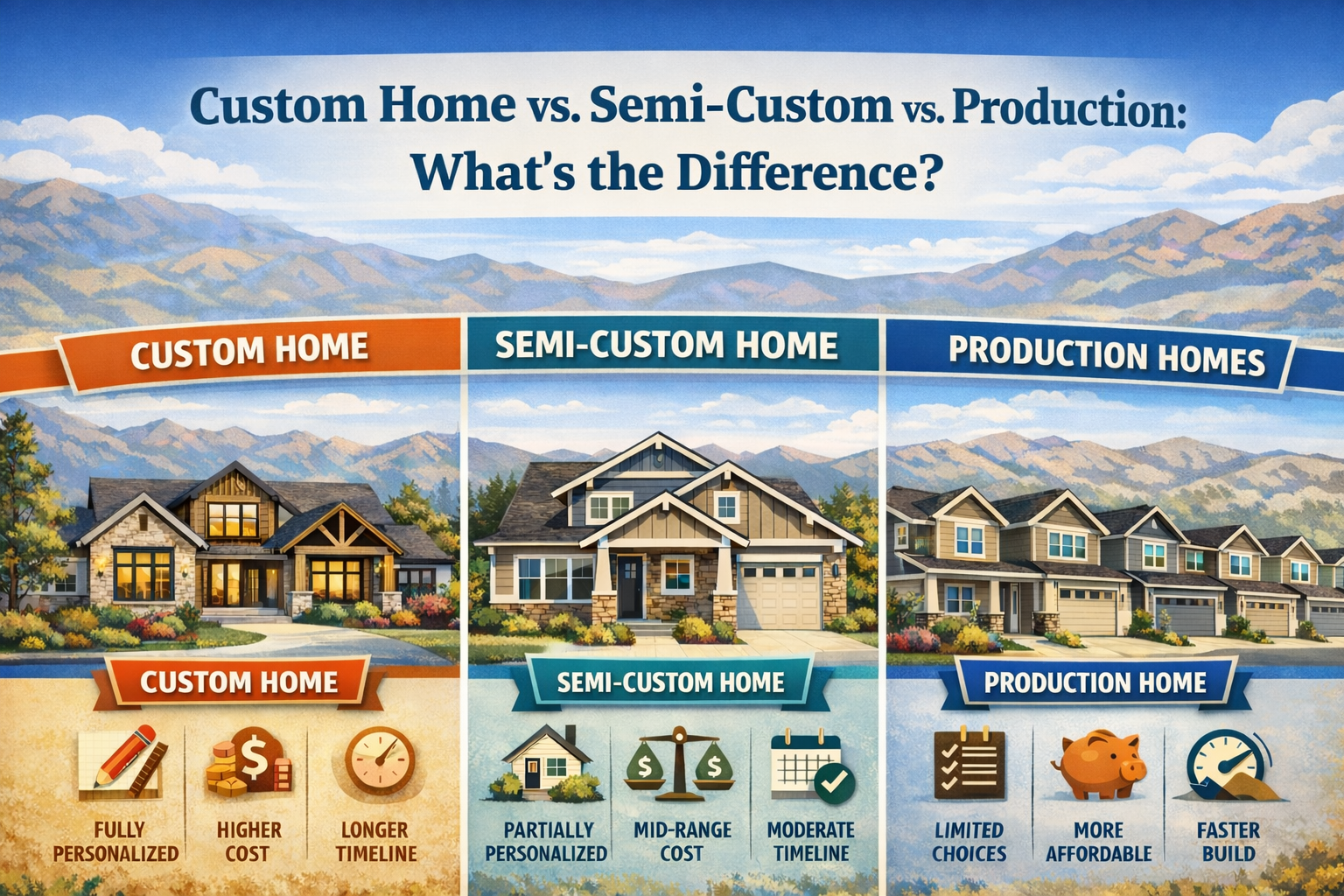
  • Custom Home vs. Semi-Custom vs. Production: What’s the Difference?

    Custom Home vs. Semi-Custom vs. Production: What’s the Difference?

    By Sunrise Realty Group

    If you’re thinking about building a new home in Idaho, one of the first big decisions you’ll face is which path to take in the custom vs semi-custom vs production home conversation.

    In other words: do you want a fully custom home designed from a blank slate, a semi-custom home based on an existing floor plan, or a production (spec) home built by a tract builder in a planned community?

    Each type of home offers a different level of design flexibility, cost, and involvement in the home-building process. Understanding those differences clearly can help you make an informed decision that better aligns with your budget, timeline, and your family’s needs.

    This guide breaks down each type of home in clear, simple terms—so you can decide which option is the best fit for your lifestyle and long-term goals in the Treasure Valley.

    What Is a Production Home?

    A production home is the simplest and most affordable type of new construction. Production homes are typically built by tract builders (CBH Homes, Hubble Homes, Lennar, etc.) who are large production home builders who work from a set of pre-designed floor plans in a subdivision or master-planned community.

    Instead of starting with a blank slate, you choose from a set of standard floor plans offered by the builder. This allows the builder to streamline the construction process, control costs, and deliver high-quality homes at lower prices with less time from contract to move-in.

    Key Features of a Production Home

    Production homes usually share several characteristics:

    • A set of floor plans or house plans to choose from
    • Pre-designed structural layouts with less flexibility for changes
    • Standard finishes with upgrade packages for things like countertops, flooring, or paint colors
    • A predictable construction process with defined stages and timelines
    • Often built on smaller or uniform lots within the same neighborhood
    • Energy efficiency measures are commonly included as part of the builder’s standard package

    Many production builds are also referred to as spec homes or spec houses, especially when the builder starts construction before a specific buyer is under contract.

    Who a Production Home Is Best Suited For

    A production house is often the right choice for a:

    • Home buyer with a strict budget who still wants a new home
    • Buyers who prefer a move-in-ready home with fewer decisions to make
    • Families that want to be in a specific subdivision, school district, or community with amenities
    • Buyer who values a streamlined path and doesn’t need a high level of personalization

    For many people, production homes are an attractive option because they offer a lower cost of entry into new home construction and a shorter amount of time between signing a contract and receiving the keys.

    Pros of a Production Home

    • Lower cost compared to custom and many semi-custom builds
    • The fastest build time of the three options
    • Fewer decisions, which means less design fatigue
    • Clear base price and upgrade options upfront

    Cons of a Production Home

    • Limited design flexibility and structural changes
    • Less control over specific design elements or special features
    • Many homes in the community may share similar home designs and exterior materials

    What Is a Semi-Custom Home?

    A semi-custom home sits in the middle of the custom vs semi-custom vs production home spectrum. It blends flexibility with structure, and it’s often the best route for buyers who want more personalization than a production home—but don’t need the complete freedom (or full cost) of a true custom home.

    With a semi-custom home, you usually start with an existing floor plan from a semi-custom builder and then adjust it to your specific needs.

    Key Features of a Semi-Custom Home

    Semi-custom builds typically include:

    • A library of pre-designed floor plans or house plans to start from
    • The ability to make layout changes, such as moving walls, adding a bedroom, or reconfiguring the kitchen
    • A wider range of design options for finishes, fixtures, and exterior materials
    • More involvement in the design process, especially in the design phase
    • A mid-range price point between production and fully custom homes

    You’ll work with a design team or semi-custom builder to ensure the home’s construction reflects your lifestyle, specific needs, and price range.

    Who a Semi-Custom Home Is Best For

    A semi-custom home is often the best fit for:

    • Buyers who want a more personalized home without going all-in on a fully custom build
    • Families who have specific ideas about layout and storage but don’t need complete control over every detail
    • People who want a smoother, more structured process than a full custom project, but more design freedom than production homes

    Pros of a Semi-Custom Home

    • Greater level of personalization than production homes
    • The ability to adapt an existing floor plan to your family’s needs
    • A clearer starting point for budget and timeline than a complete custom build
    • Often, a good “middle ground” for many home buyers

    Cons of a Semi-Custom Home

    • More decisions to make than with a production home
    • Significant changes or structural changes can add additional cost.
    • The build may still take more time than a production home, especially if you request many modifications.

    What Is a Custom Home?

    A custom home offers the highest level of customization—and the most design freedom—among the three options. Here, you’re not starting with a standard plan or existing floor plan; you’re working with a custom home builder or design-build team to create a fully custom home from the ground up.

    Custom home projects usually start with a blank slate: your land, your ideas, and a design team that helps shape them into a complete set of house plans.

    Key Features of a Custom Home

    With a whole custom home, you can expect:

    • A fully original floor plan and architectural style
    • Complete control over room sizes, layout, and overall square footage design
    • The chance to incorporate specific design elements, special features, and unique home concepts
    • Tailored solutions to your land, views, and topography—especially if you own land already
    • The ability to specify exterior materials, energy efficiency features, and final finishes

    Custom home building is ideal for buyers who want their dream home to reflect a clear vision and specific needs that standard plans can’t meet.

    Who a Custom Home Is Best For

    A true custom home is often the right choice when:

    • You already own land or want to choose the land first and design around it.
    • You have detailed ideas about layout, architectural style, and special features.
    • You’re comfortable with a longer design-build process and a higher overall budget.
    • You want a one-of-a-kind home that doesn’t look like anything else in your neighborhood.

    Pros of a Custom Home

    • Complete control over the design process and final product
    • The highest level of personalization in layout, finishes, and performance features
    • Optimized use of your land, views, and site conditions
    • Potential for higher long-term value when done well

    Cons of a Custom Home

    • Typically, the highest cost and most extensive price range
    • The amount of time from the first decision to move-in is usually the longest.
    • Requires close coordination between your custom builder, design team, and lender
    • More decisions and more complexity throughout the construction process

    Custom vs Semi-Custom vs Production Home: Side-by-Side Comparison

    When you line up custom vs semi custom vs production home options, the differences become clearer. Here’s a simplified way to think about them:

    FeatureProduction HomeSemi-Custom HomeCustom Home
    CostLowest base price / lower costMid-range, depends on changesHighest, widest price range
    Design FlexibilityLowest design flexibilityModerate level of customizationUnlimited design freedom
    TimelineFastest / less timeModerateLongest amount of time
    Floor PlansFixed set of floor plansPre-designed floor plans with modificationsFully original plans
    DecisionsFewer decisions to makeMore decisions, guided by builderMost decisions across all phases
    Best ForBudget-focused, move-in ready buyersBuyers wanting balance between cost & customizationBuyers wanting full control & unique design
    LandUsually builder-owned lotsOften can build on your own lotCommonly built on land you own or select

    This comparison can help you quickly see which path best suits your budget, timeline, and level of involvement.

    How to Choose the Right Type of Home (and Builder)

    When you’re deciding between custom vs semi-custom vs production home paths, it often helps to think in terms of:

    1. Budget and Price Range
      • If you need the lowest possible base price and a simpler path, production homes or spec homes can be an attractive option.
      • If you invest more in personalization, semi-custom builds, or full-custom homes, you can open up more possibilities.
    1. Level of Customization You Want
      • If you’re comfortable with a standard plan and a few design options, production builds may be the right route.
      • If you have specific needs for your family, a semi-custom home offers a good balance.
      • If you want complete control and a truly unique home, a fully custom build is the natural choice.
    1. Amount of Time and Involvement
      • Production homes tend to require less time and fewer decisions.
      • Semi-custom and custom houses involve more meetings, design decisions, and ongoing input, but also lead to a more personalized home.
    1. Land Situation
      • If you don’t own land and want a quick, streamlined path, production home builders with move-in-ready home options might be ideal.
      • If you already own land or want to select land first, a semi-custom builder or custom home builder can help you align the home design with your site.

    Working with the right builder is just as important as choosing the right type of home. Look for production builders, semi-custom builders, or custom builders with a track record of high-quality homes, clear communication, and expert guidance through the design-build process.

    Next Steps in Your Home Building Journey

    Choosing between custom vs semi-custom vs production home options is one of the first—and most important—decisions in the home construction journey. 

    There’s no single “right decision” that applies to everyone; instead, the best fit depends on your:

    • Budget and long-term goals
    • Desired level of design freedom
    • Willingness to be involved in the design process
    • Timeline for moving into your new home

    Idaho’s growing market offers all three paths, from production homes in master-planned communities to semi-custom builds and full custom home design on acreage or view lots.


    If you’d like expert guidance on which type of builder and which type of home is the best route for your situation, Sunrise Realty Group can help you sort through your options, clarify your priorities, and move confidently toward the home of your dreams.

    Contact us now.

    Differences between a custom vs semi custom vs production home; choose the right builder, budget, and design path for your new home in Idaho.

  • Mistakes When Buying Land in Idaho: Top 9 to Avoid

    Mistakes When Buying Land in Idaho: Top 9 to Avoid

    By Sunrise Realty Group

    Buying a piece of land for your home can feel like a dream, but do you know what the journey will look like? Believe it or not, understanding the most common mistakes when buying land in Idaho is essential to making the wish come true.

    Whether you’re a first-time buyer dreaming of a quiet rural property, a foothills view lot near Boise or the perfect piece of land to build your custom home. In recent years, land purchases across Idaho have surged as buyers seek more space, natural beauty and long-term flexibility.

    Buying land is a whole different ballgame compared to purchasing an existing home. Land purchasing comes with more unknowns, requires extra homework and carries bigger risks if key steps are missed.

    Mistakes can run into surprise costs, legal headaches or even worse; you find out the land isn’t exactly what you thought you wanted.

    Here are some of the most common mistakes people make when buying land in Idaho—and how you can steer clear of them to make a smart decision and safeguard your investment.

    1. Buying Land Without Verifying Buildability

    This is the most common—and most costly—mistake land buyers make. Just because a plot of land looks beautiful does not mean it is a suitable building site.

    Before jumping in with an offer, you need to make sure the land is actually buildable. Buildable land will be legally approved for construction and physically capable of supporting a home. 

    The last thing you want is to buy a piece of land only to find out later that zoning laws, permits or the terrain itself make building impossible. A little extra research at the start of your real estate endeavor will save you a lot of headaches down the road.

    Important buildability checks include:

    • Septic system approval from local health departments
    • Well feasibility and water rights
    • Legal access and recorded easements
    • Zoning classifications and local zoning maps
    • Required setbacks from property lines
    • Soil quality and slope stability
    • Fire access and road requirements

    A failed soil test or lack of essential utilities can dramatically reduce land value or prevent construction altogether.

    2. Not Understanding Septic System Requirements

    Many vacant land parcels in Idaho—especially in rural areas—are not connected to public sewer systems. This makes septic approval a critical step in land ownership.

    Common septic-related issues include:

    • Poor soil or clay-heavy ground
    • High water tables or flood zones
    • Insufficient land area for drain fields
    • Conflicts with property lines or wells
    • Portions of land restricted by deed restrictions

    Always include a perc test or septic contingency in your offer. This is a crucial role of due diligence and one of the first things first-time buyers should confirm.

    3. Assuming a Well Can Be Drilled Easily

    Water access can be “all over the place” in Idaho, depending on where you’re looking whether it’s up in northern Idaho, the Treasure Valley or somewhere else. 

    Some parcels have easy access to groundwater, but others? Not so much. It’s definitely something to keep in mind when scouting for land.

    Common surprises include:

    • Deeper-than-expected wells
    • Low gallons-per-minute output
    • Poor water quality requiring filtration
    • Shared-well agreements that limit use

    Well-drilling costs can take a big bite out of your budget and even affect the long-term value of your new land.

    That’s why checking water feasibility before you commit to buying land is a must. It’s one of those things that might feel like extra work now, but worth it.

    4. Overlooking Utility Availability and Costs

    Many land buyers assume essential utilities are nearby—but that’s often not the case, especially in rural properties or areas with low population density.

    Utility considerations include:

    • Power availability and extension costs
    • Water lines or private water systems
    • Storm drain requirements
    • Internet access for remote work
    • Propane or alternative fuel options

    Utility extensions can add tens of thousands of dollars to a land purchase and should be evaluated early during due diligence.

    5. Ignoring Zoning, Deed Restrictions and Local Regulations

    Zoning laws and deed restrictions often define how much control you have over your own property. Many times, buyers don’t realize they have restrictions associated with a property until they go to the title company to go through land records.

    These restrictions can impact what you’re allowed to build, how you can use the land and whether things like outbuildings, guest houses or livestock are allowed.

    Taking the time to review these details early on can save you from expensive surprises later and make sure the land actually fits your plans before you get too attached.

    Key zoning considerations include:

    • Agricultural use versus residential use
    • Commercial purposes restrictions
    • Minimum square footage requirements
    • Outbuilding and accessory structure limits
    • Short-term rental rules
    • Local building codes

    Buyers will always want to review restrictions with real estate experts before proceeding.

    6. Underestimating Soil Quality and Topography

    Idaho’s dramatic terrain, while visually appealing, can significantly increase construction costs.

    Challenging conditions include:

    • Steep slopes
    • Lava rock near the surface (which could require you to blast)
    • Poor soil or expansive clay
    • Erosion zones
    • Railroad proximity or unstable fill

    Geotechnical soil testing and land surveying will help you to identify issues early and help protect your land value.

    7. Assuming Land Is Cheaper Than Buying a Home

    Many buyers believe vacant land is a simpler and less expensive option—but that’s not always the case.

    Hidden land costs include:

    • Septic systems and wells
    • Physical improvements and site prep
    • Surveys and engineering
    • Driveways and access roads
    • Impact fees and tax rates
    • Title insurance and land loans

    A parcel priced attractively may exceed your budget once development costs are included.

    8. Not Planning for Appraisal and Financing

    Land loans and construction loans have stricter requirements than traditional mortgages.

    Issues arise when:

    • Market value doesn’t support the build
    • Comparable land sales are limited
    • Down payments are higher than expected
    • Credit unions or local banks have stricter lending criteria

    Understanding land value and future appraisal potential is essential for long-term success.

    9. Working With the Wrong Professionals

    Land transactions require specialized knowledge. Not all real estate agents may be equipped to navigate the complexities of land ownership.

    You need professionals who understand:

    • Land surveys and title issues
    • Water rights and mineral rights
    • Local regulations and building codes
    • Previous known uses of the land
    • Needs of anticipated growth and future developments

    This is where experienced real estate practitioners and land experts make a critical difference. If you want to learn more about buying land, check out our step-by-step guide to buying land in Idaho.

    How the 3-One Method Helps You Avoid These Mistakes

    The 3-One Method ensures every step of the land-buying process stays aligned:

    One Guide

    A single expert guiding land buyers through due diligence, land value analysis and feasibility.

    One Vision

    Your long-term goal, budget and land use remain aligned.

    One Seamless Path

    From land sales to building permits, you avoid common mistakes and unnecessary delays.

    Final Thoughts

    Buying land in Idaho offers outstanding reasons to invest—natural beauty, outdoor activities and unmatched flexibility. Land ownership requires careful planning, thorough research and the proper guidance.

    By avoiding these common mistakes when buying land in Idaho, you can protect your investment, secure a buildable parcel and move confidently toward your future home or long-term vision.


    The Sunrise Realty Group specializes in helping land buyers make informed decisions, from vacant land to completed homes, every step of the way. Contact us today.

  • How Appraisals Work for New Construction in Idaho

    How Appraisals Work for New Construction in Idaho

    If you’re planning to build a home in Idaho—whether for a personal home or for a client—one of the most important (and most misunderstood) steps in the process is the new-construction appraisal.

    Unlike an appraisal for an existing home, a new-construction appraisal is based on something that doesn’t exist yet.
    That means the appraiser must estimate the future value of your home using the plans, specifications, and comparable sales in the area.

    Understanding how this process works can save you time, stress, and money—and help you avoid costly redesigns or loan delays.

    This guide breaks down everything Idaho buyers need to know about how new-construction appraisals work in the Treasure Valley and beyond.


    What Makes a New-Construction Appraisal Different?

    When buying an existing home, the appraiser evaluates things like:

    • Current condition

    • Upgrades

    • Age of the home

    • Recent sales nearby

    But with new construction, the home isn’t built yet.

    So instead, the appraiser evaluates such things as:

    • The building plans

    • The materials and finishes

    • The overall construction budget

    • The land value

    • Comparable new builds in the area

    • Local market conditions

    The result is called a “subject-to appraisal”—meaning the value of a home is subject-to completion of construction and is ready to be sold or moved into.


    Why Do Lenders Require a New-Construction Appraisal?

    Lenders need to ensure that things such as the following are looked at:

    1. The total project value supports the loan amount

    2. The home won’t be worth less than what it costs to build

    3. The build is appropriate for the neighborhood and market

    Construction lending can be higher risk so appraisals are essential for protecting both the lender and the buyer.


    What Appraisers Look At for Idaho New Construction

    Let’s break down four of the major components of new-construction appraisals to look at them more closely:


    ✔ 1. Land Value

    The appraiser determines the value of the land based on several factors. Some examples include:

    • Location

    • Acreage

    • Zoning

    • Access

    • Utilities

    • Terrain

    • Recent land sales

    In Idaho—especially Ada and Canyon counties—land values can vary dramatically between areas.

    A half-acre in Eagle could cost the same as five acres in Middleton.


    ✔ 2. Your Construction Plans

    The appraiser reviews the construction plans to look at such things as:

    • Floor plan layout

    • Exterior elevation design

    • Square footage

    • Number of bedrooms and bathrooms

    • Architectural style

    • Energy-efficiency features

    • Materials and finishes

    Higher-end features may add value, but only if they match comparable homes nearby.


    ✔ 3. Your Builder’s Cost Breakdown

    Builders must provide a detailed line-item budget to show generally how much it will cost to build the home. Costs the  appraiser looks at include things like:

    • Foundation

    • Framing

    • Electrical, plumbing, and HVAC

    • Siding and roofing

    • Flooring and cabinetry

    • Fixtures and finishes

    • Labor

    • Permits

    • Site prep and utilities

    The appraiser checks that these costs align with market norms of other homes being built.


    ✔ 4. Comparable Sales (Comps)

    This is the most important part.

    The appraiser looks at the subject property/project and finds recently sold homes that have similar traits such as:

    • Location proximity

    • House size

    • Style

    • Quality

    • Acreage or lot size

    If there are no perfect comps (common in Idaho rural areas), the appraiser adjusts values based on differences.


    Why Appraisals Sometimes Come in Low in Idaho

    There are several common reasons:

    1. Overbuilding for the neighborhood

    If nearby homes average $600k, a $1M home may not appraise.

    2. Unique or highly custom features

    Appraisers rely on comps—if no similar homes exist, it’s harder to justify the value.

    3. Rural or acreage properties

    Large-acreage custom homes are difficult to compare.

    4. Rapid market shifts

    Idaho’s market can change faster than the sales data behind appraisals.

    5. Lack of new-construction comps

    Especially in areas like Emmett, Middleton, or South Nampa where home styles vary widely.


    How to Improve Your Chances of a Strong Appraisal

    ✔ Work with a builder who knows Idaho markets

    Experienced builders understand what features add real value—and what buyers in that area expect.

    ✔ Keep your design in line with neighborhood standards

    Value is heavily tied to surrounding homes.

    ✔ Choose timeless, in-demand features

    Idaho appraisers typically reward:

    • Open floor plans

    • High-quality windows

    • Energy efficiency

    • Practical layouts

    • Covered patios

    • RV bays in rural areas

    ✔ Avoid overly niche design decisions

    The market must support your tastes.

    ✔ Work with an agent who understands land AND new construction

    This is precisely the gap the 3-One Method closes—keeping your land, design, budget, and appraisal aligned from the start.


    When Does the Appraisal Happen?

    A construction loan appraisal timeline typically happens within the following steps leading to the construction of a home:

    1. Choose land

    2. Create your home design

    3. Get bids from builders

    4. Appraisal is ordered

    5. Apply for construction loan

    6. Loan is approved

    7. Permits

    8. Begin construction

    Appraisals happen before you break ground, not after.


    Do Appraisers Revisit the Property After Construction?

    Yes—lenders require:

    • Draw inspections

    • Progress checks

    • Final inspection once completed

    The final inspection verifies that the home was built according to the plans used for the appraisal.


    Final Thoughts

    Appraisals are one of the most important steps in building a home in Idaho—and understanding how they work can help you avoid frustration, unexpected costs, and delays.

    An appraisal is never a guarantee however when managed correctly, an appraisal helps to ensure:

    • Your project is financially sound

    • Your design matches the market

    • Your loan is secure

    • Your home builds equity during the early days of ownership

    If you’re planning to build a home and want help navigating things such as:

    • Land selection

    • Design

    • Builder bids

    • Construction financing

    • Appraisal strategy

    The Sunrise Realty Group is here to guide you through every step.

  • Idaho Construction Loans: How Much House Can You Build?

    Idaho Construction Loans: How Much House Can You Build?

    Building a home in Idaho is an exciting journey — and the very first question most people have about a construction loan is simple:

    “How much house can I actually afford to build?”

    Unlike buying an existing home with a traditional mortgage, new construction requires a home construction loan during the construction phase. These loans come with specific rules, lender requirements, and approval limits that directly impact your budget.

    Understanding Idaho construction loan limits helps you set a realistic plan, avoid surprises, and design a home that aligns with what lenders will approve. This guide explains loan types, down payment expectations, appraisal influences, and factors that affect your loan amount from start to finish.

    What Makes Construction Loans Different in Idaho?

    Construction loans are short-term, interest-only loans that cover:

    • Land
    • Site prep
    • Materials
    • Labor
    • Utilities
    • Permits
    • Engineering
    • Inspections

    Once the construction of a new home is complete, the loan converts into a permanent loan (also known as the end loan), or you close a construction loan and refinance into a longer-term fixed-rate mortgage.

    Unlike a traditional mortgage, construction financing requires:

    • More documentation
    • Approved architectural plans
    • A licensed Idaho builder
    • A detailed cost breakdown
    • A higher credit score
    • Verification that the project is feasible
    • A draw schedule for the construction period

    Construction costs fluctuate during construction and understanding lending limits before you design your home is crucial.

    How Construction Loan Limits Work in Idaho

    Construction loan limits depend on four major factors.

    1. Your Down Payment or Equity in the Land

    Most Idaho lenders require a down payment for primary home, secondary home or a vacant lot.

    If you already own the land, its value often counts as equity toward loan approval. A good amount of equity can significantly reduce the upfront cash required.

    Example:

    If your land is worth $150,000 and you own it free and clear, that value could possibly be treated as your down payment.

    2. The Type of Loan You Qualify For

    There are several different types of construction loans available in Idaho:

    • Conventional Construction Loans

    There are conforming loan limits in Idaho. These limits include both the land and the building of a new home. Anything above the conforming loan limits could possibly require a jumbo construction-only loan or a construction-to-permanent loan.

    • Jumbo Construction Loans

    For larger construction projects or higher market values.

    They require:

    • Strong credit history
    • Larger down payment
    • Clean credit approval
    • Proven financial stability
    • FHA Construction Loans

    FHA’s One-Time Close program allows lower down payments, but the FHA loan limit for Idaho (most counties)  including land and construction is lower.

    This makes FHA a better fit for modest construction projects or a smaller renovation project.

    VA Construction Loans

    VA loans offer zero-down options for eligible borrowers, but only certain credit unions and lenders in Idaho offer them.

    Lenders typically cap VA loans due to risk tolerance.

    3. The Appraised Value of the Finished Home

    Lenders use a “subject-to” appraisal meaning the home is appraised as if it were already built. The appraisal affects your final loan amount and whether private mortgage insurance may apply.

    If the appraisal comes in low, you may need to:

    • Increase your down payment
    • Negotiate prices down
    • Reduce square footage
    • Consider lower cost materials (siding, fixtures, appliances, etc)
    • Find ways to pay for certain things yourself

    This is one of the most important steps in the construction mortgage process.

    4. Your Debt-to-Income (DTI) Ratio

    Most Idaho lenders require a certain Debt-to-Income ratio (DTI) to qualify for for a loan. Ultimately it’s your DTI that determines the size of the monthly payments you can afford, which directly affects your construction loan product options.

    For more information about this see our article on Debt-to-Income Ratio (DTI) and lenders.

    5. Top 5 Ways to Increase How Much House You Can Afford to Build

    • 1. Use land equity

    Land equity reduces cash needed and increases approval odds.

    • 2. Lower debts

    Reducing your credit card balances, personal loans or auto loans improves your DTI.

    • 3. Choose a design that appraises well

    Higher-end Idaho appraisals favor:

    • Simple rooflines
    • Efficient layouts
    • Functional square footage
    • Desirable areas
    • 4. Work with an Idaho lender experienced in construction loans

    Choose a reputable lender that is familiar with typical Idaho construction and draw schedules.

    • 5. Start with a realistic plan

    It is very common for home owners (especially first time home buyers) who are designing their own home to design themselves into a problem because they do not understand what things cost. 

    Frankly, no one can know what the construction cost is going to be without designing a home and having it bid out to the different trades involved in the construction process. Due to the nuances of building a new home, designing it exactly the way you want it and then bidding it out is the only way to know if you can truly afford the home. 

    With the 3-One Method however we are going to be able and assist you with this a little more than others due to our knowledge of the industry and our relationships with builders. Things change daily in terms of cost and having these relationships with different builders allow us to help give you a little more insight ahead of time.

    6. It is Important to Get Pre-Approved on Your Loan Ahead of Time

    Designing your home before knowing the construction loan limits is never a good idea. Getting a pre-approval on a loan before designing a home saves you from not wasting time and money. Knowing the loan amount allows the builder to know what you can afford and allows a builder (and a real estate agent) to guide you accordingly.

    Final Thoughts

    Understanding Idaho construction loans and how lenders calculate your maximum build budget is the first step in designing a home you can actually complete. When you know how the loan type, land equity, credit score and appraisal influence your approval, the construction process becomes much smoother.

    Whether you’re exploring a renovation loan, a new construction loan, an owner-builder construction loan or a full construction-to-permanent loan, getting clarity early can create a solution for your specific financial situation.

    If you want help:

    • Understanding how much home you can build
    • Evaluating a vacant lot or piece of land
    • Finding favorable terms with a reputable construction loan lender
    • Matching with a mortgage loan officer
    • Designing a plan that fits your loan amount and budget

    The Sunrise Realty Group is here to guide you every step of the way. Contact us today.

    Learn how Idaho construction loans work, loan limits, and how much home you can build. Understand construction loan requirements, down payments, and approval tips.
  • How to Buy Land in Idaho: A Step-by-Step Guide for First-Time Buyers

    How to Buy Land in Idaho: A Step-by-Step Guide for First-Time Buyers

    Buying land in Idaho is exciting — and if you’re preparing to buy land in Idaho for the first time, you’ll quickly discover the process is very different from purchasing a standard home. 

    Whether you’re dreaming of a rural acreage near snow-capped mountains, a city lot in Boise raw land bordering national forest or private land you must evaluate zoning, utilities, soils, water rights and the current use of the land before you move forward.

    Properties with existing homes on them already usually answer many questions upfront. However, with vacant land confirming access, electric service, soil type, water line availability, septic potential, mineral rights, storm drainage and whether the land is genuinely suitable for your goals is important to look into.

    This guide walks you through the proper procedures and basic steps for buying land in Idaho, especially if this is your first time in the Gem State.

    Why Buying Land in Idaho Is Unique

    Idaho’s real estate market includes diverse terrain, rural land opportunities and strict environmental requirements. 

    When evaluating rural properties, acreage or parcels near wildlife preserve areas the following needs to be verified:

    • What are the Utilities available?
    • Is a Septic system and (or) well required?
    • Is there Slope and what types of soils are on the property?
    • Is there is a subdivision and does the property have CC&Rs, a HOA or builder restrictions?
    • What is the zoning?
    • Are there Irrigation and (or) water rights?
    • What is the legal access?
    • Are there any easements?

    With so many potential variables, purchasing land requires more due diligence than buying a home with existing physical improvements because they can sometimes be easier to determine.

    STEP 1: Determine What Type of Idaho Land You Want

    Before searching for land, decide which type fits your goals, budget, and intended needs. The following are examples of properties you may come across:

    City Lots

    • Common in Boise, Meridian and Eagle
    • Typically easier to develop
    • Often already connected to city utilities

    Neighborhood/Subdivision Lots

    • Often governed by HOAs and CC&Rs
    • May require a specific builder(s)
    • Typically smaller but simpler to develop

    Rural Land / Acreage

    • More privacy and space
    • Often requires well, septic and utility installation
    • Popular in Star, Middleton, Kuna, Nampa and Caldwell

    Foothill & Sloped Lots

    • Beautiful scenery
    • Rock, slope, and hillside codes increase cost
    • May require additional tests and (or) engineering

    STEP 2: Choose the Right Location — One of the MOST Important Decisions When You Buy Land in Idaho

    Location affects every part of the land-buying process, including cost, legal access, building site restrictions and long-term value.

    • Proximity to Work, Schools, and Daily Needs

    Think about what daily life will actually feel like once you’re home:

    • What does that look like?
    • How long will the commute to Boise or Eagle be?
    • Would you need to be close to grocery stores, a specific school district, hospitals or emergency services?

    All important aspects of daily life to consider.

    And be honest with yourself — Do you thrive on the quiet of rural living or do you prefer the convenience that comes with being closer to town?

    There are pros and cons to everything in life. If you are planning to buy land in Idaho near Star or Middleton you will likely enjoy more space and privacy, but your drive times may stretch a bit. Weigh your options out thoughtfully.

    • Utility Availability in the Area

    Utility access varies widely across the Treasure Valley. Before the purchase of the land, verify:

    • If you need city water and sewer or if you need septic and well
    • What the nearest gas line or propane requirements are
    • What the power and electric service availability is
    • What the Internet or cable TV company coverage is

    A property’s required utility extensions could even possibly add cost to your total purchase price.

    • County and Zoning Requirements

    Zoning rules cover things like setbacks, outbuilding regulations, density and lot size, livestock allowances and short-term rental restrictions.

    Every building department will have their own zoning requirements so consider different factors carefully. For example, In the Boise foothills, zoning often includes specific guidelines for hillside development and important safety considerations.

    Working with an expert in Idaho land and foothills zoning can help you understand what is allowed, what isn’t and how those rules may affect your building plans.

    • Neighborhood Character & Future Development

    Be sure to research the following topics during your due diligence:

    • Potential future road expansions
    • Commercial or residential developments
    • Planned communities
    • Boundary changes
    • Impact fees
    • Irrigation district rules

    With Idaho growing like it is (and will likely continue to do so for the foreseeable future) a quiet roadway now could become a major connector later.

    • Natural Terrain & Environmental Factors

    The terrain plays a big role in both the engineering and cost of a project.

    Things like soil type (whether it’s clay, sand, rocky or has a high water table), drainage, flood zones, wildlife corridors, proximity to hazardous dump sites and nearby rocks or slopes all come into play.

    An inexpensive lot at first, may require expensive site work costs later.

    STEP 3: Set a Realistic Land Budget

    When planning your budget, don’t just think about the purchase price—make sure to factor in the following as potential costs:

    Land Preparation Costs

    • Power installation
    • Well or water connection
    • Septic system
    • Driveway or access road
    • Grading or clearing
    • Storm drainage improvements

    Soft Costs

    • Perc test
    • Soil evaluation
    • Boundary survey of the land
    • Environmental checks
    • Proof of title review
    • Preliminary title report

    Buying inexpensive land in the wrong area can be more costly than a better lot in a smarter location.

    STEP 4: Evaluate Whether the Land Is Buildable

    Before writing an offer, make sure you understand the following about the property:

    Utilities

    Power, water rights, sewer/septic capacity, gas and internet.

    Legal Access

    • Does it have a public road or deeded easement?
    • Year-round accessibility?

    Verify the legal description of the land.

    Zoning & Restrictions

    County rules, CCRs, HOAs, livestock rules, building codes, street lights and setback rules.

    Septic Suitability

    Perc test approval via local health districts.

    Water Rights

    Irrigation district rights and surface water rights.

    Soils

    Type of soil: poor soil, clay, sand or high water table.

    These determine the long-term feasibility and development costs.

    STEP 5: Order Key Land Tests Before Committing

    You will want to (or you may be required to) schedule the following:

    • A soil evaluation
    • A perc test
    • A boundary survey
    • A utility verification
    • A water rights confirmation

    These tests will give you a pretty clear picture of what you’re actually buying and protect you from surprises the selling party may not mention.

    STEP 6: Make an Offer with Proper Land Contingencies

    Be sure to consider including the following contingencies when buying land:

    • A feasibility contingency
    • A perc test contingency
    • A survey contingency
    • A water rights contingency
    • A utility access contingency

    Contingencies ensure you can walk away if major problems with the seller occur or unseen land conditions appear.

    STEP 7: Close on the Land

    Once due diligence is completed:

    • Finalize financing or owner financing if negotiated
    • Sign closing documents
    • Ensure proof of ownership transfers
    • Record the deed
    • Update irrigation or water rights
    • Verify proper easements

    Congratulations — you now own land in Idaho with outstanding reasons to invest.

    Common Mistakes Idaho Land Buyers Should Avoid

    • Not researching utility availability
    • Forgetting to verify legal access
    • Assuming all rural land is automatically buildable
    • Overlooking zoning restrictions or local jurisdiction rules
    • Ignoring water rights or storm drainage requirements
    • Skipping the perc test
    • Not checking previous known uses of the land
    • Buying before reviewing potential hazardous dump sites
    • Skipping geological checks from the U.S. Geological Survey
    • Trying to buy land in Idaho without professional guidance

    Buying land is simple. Buying the right land takes research, due diligence and guidance from real estate professionals who understand Idaho’s unique land challenges.

    Final Thoughts

    Idaho truly offers some of the most diverse and beautiful land in the West — from rural acreage to subdivisions to parcels near national forests. 

    But before you buy land in Idaho, understanding access, zoning, utilities, soils and water rights is essential to avoid expensive mistakes and keep your building project on track.


    Whether you’re exploring city lots, rural properties or private land near foothills, The Sunrise Realty Group is here to help you find land that aligns with your long-term goals. Contact us now.