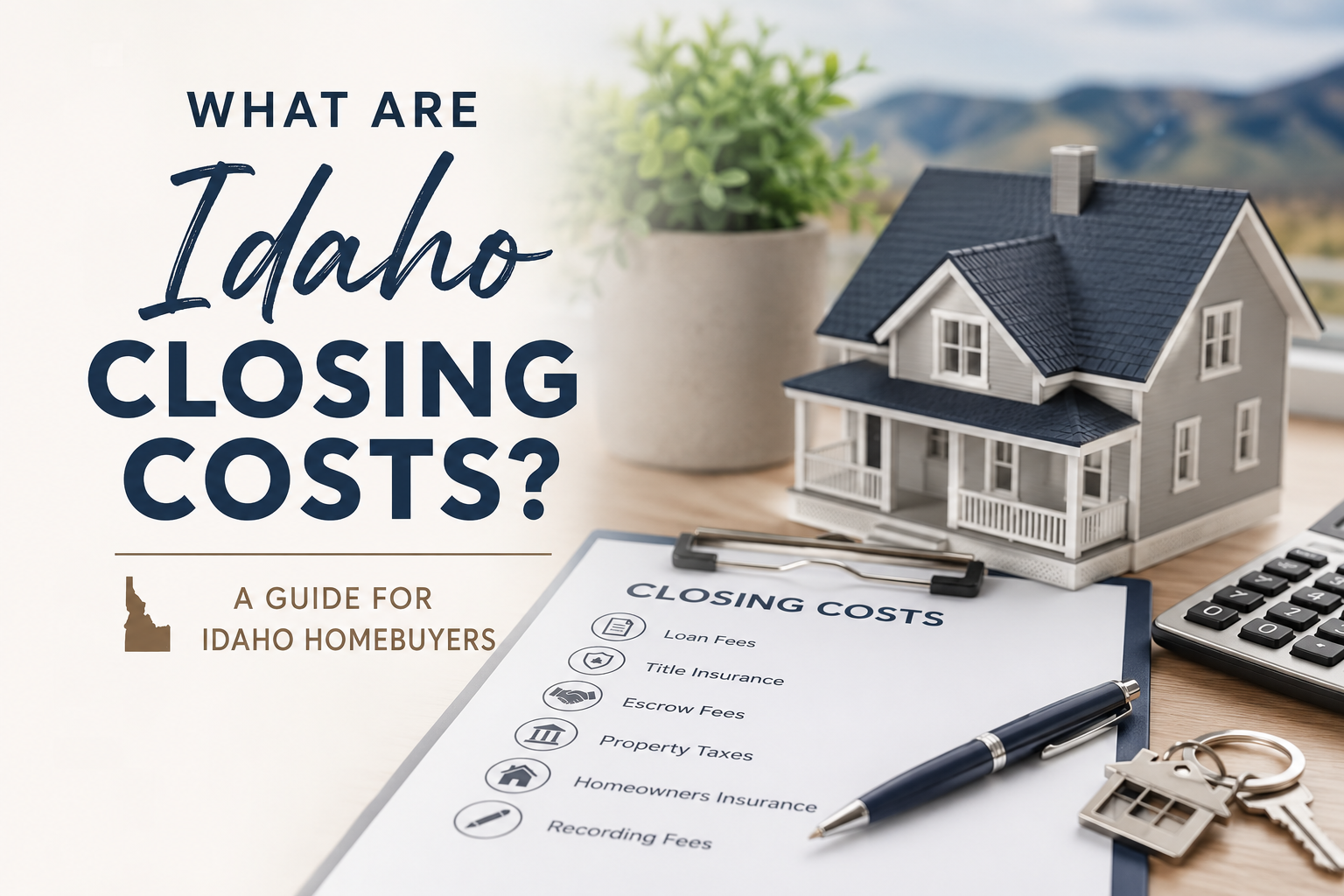
If you’re planning to buy a home in Idaho, you’ve probably heard the term closing costs. For many first-time buyers, these expenses can come as a surprise because they are separate from the home’s purchase price and your down payment. Understanding what closing costs are before you begin shopping for a home can help you prepare financially and make the buying process much less stressful.
What Are Closing Costs?
Closing costs are the collection of fees and expenses that are paid when the purchase of a home is finalized. They cover the services and administrative work required to transfer ownership from the seller to the buyer and complete the mortgage process.
Rather than being a single fee, closing costs include several different charges that are paid to various professionals and organizations involved in the transaction.
What Do Closing Costs Pay For?
Depending on your purchase, closing costs may include expenses such as:
Loan processing by your lender
Property appraisal
Title search and title insurance
Escrow services
Recording the new ownership with the county
Homeowners insurance
Property taxes and prepaid interest
Homeowners association fees, if applicable
Each of these plays an important role in ensuring your home purchase is completed legally, accurately, and with as few surprises as possible.
Why Do Closing Costs Matter?
Many buyers spend months or even years saving for a down payment but don’t realize they will also need to account for closing costs. Planning for these expenses early can help prevent delays and make the closing process much smoother.
Knowing about closing costs also allows you to have informed conversations with your lender and real estate agent so you understand exactly what you’re paying for and why.
Can Closing Costs Be Negotiated?
In many cases, yes.
Depending on the terms of the purchase agreement and current market conditions, buyers and sellers may negotiate who pays for certain expenses. A seller may agree to contribute toward some closing costs as part of the negotiation, or a lender may offer credits that help reduce the amount you pay at closing.
Every transaction is different, which is why having experienced professionals representing you can make a significant difference.
Are Closing Costs the Same as a Down Payment?
No. These are two separate parts of purchasing a home.
A down payment is the portion of the home’s purchase price that you contribute toward the purchase. Closing costs, on the other hand, pay for the services required to complete the transaction and finalize your loan.
Because they serve different purposes, it’s important to plan for both when preparing to buy a home.
When Will I Know What My Closing Costs Are?
Your lender will provide documents throughout the loan process that outline the expected costs associated with your purchase. As your closing date approaches, you’ll receive a detailed breakdown showing each expense and explaining what it covers.
Reviewing these documents carefully gives you the opportunity to ask questions and fully understand your financial responsibilities before signing the final paperwork.
How Can I Prepare for Closing Costs?
The best way to prepare is to discuss them with your lender and real estate agent as early as possible. They can help you understand which costs are typical for your transaction, explain the purpose of each fee, and identify any opportunities to negotiate.
Planning ahead allows you to focus on the excitement of buying a home rather than worrying about unexpected expenses during the final stages of the process.
Final Thoughts
Closing costs are a normal part of buying a home in Idaho and represent the work that goes into making your purchase secure, legal, and complete. While they can seem overwhelming at first, understanding what they are and why they exist makes the home-buying process much easier to navigate.
Whether you’re purchasing your first home or your next home, having knowledgeable professionals by your side can help ensure you know what to expect every step of the way. With the right guidance and preparation, you’ll be ready to move into your new home with confidence.
If you’ve ever heard a lender, insurance agent, or real estate professional say “according to the FEMA flood map,” you might assume it’s simply a reference to general flood risk.
In reality, the FEMA flood map is the official flood hazard map used across the United States to determine flood risk, flood insurance requirements, construction standards, and lending decisions. For property owners, misunderstanding what the FEMA flood map shows can affect insurance costs, financing approval, and even the feasibility of new construction.
For buyers, builders, and landowners, a property’s position on the FEMA flood map can influence everything from required flood insurance policies to foundation design and base flood elevations.
Let’s break down what the FEMA flood map actually is, who regulates it, how it affects loans and insurance, and what property owners can do if the map does not accurately reflect their property’s flood risk.
What the FEMA Flood Map Is (Flood Insurance Rate Map – FIRM)
The FIRM is what’s known as the official flood map of a community used by the Federal Emergency Management Agency (FEMA) to identify flood hazards and determine flood insurance requirements under the National Flood Insurance Program (NFIP).
These flood hazard maps are the authoritative source used by lenders, insurance providers, builders, and local governments.
A FEMA flood map (FIRM) is used to:
Identify Special Flood Hazard Areas (SFHAs)
Assign flood zones (A, AE, AO, VE, X, etc.)
Establish Base Flood Elevations (BFEs)
Define specific areas with the highest risk of flooding
Support risk assessments and flood insurance pricing
Guide current development standards for new construction
The effective flood maps for each community are publicly available through the FEMA Flood Map Service Center, where property owners can search by street address and review their community’s flood risk.
GIS overlays and local flood hazard layers may be useful planning tools. Still, the effective FEMA flood map remains the official map of a community with legal authority for lending and insurance decisions.
Detailed analyses of flood patterns and flood waters
Measurement of average flood depths
Identification of base floodplain elevations
Modeling of storm surge and flooding in coastal areas
This information forms the basis for digital flood insurance rate maps (DFIRMs) and the National Flood Hazard Layer, which integrates flood hazard data across the United States.
FEMA frequently updates these maps through programs such as Risk MAP, working with local governments, community officials, and Cooperating Technical Partner programs to incorporate improved data and flood hazard information.
In many communities, updated flood studies include:
Sea level rise modeling
Changes in drainage areas
New rainfall patterns and heavy rains
Urban development impacts
Revised average depths and water flow calculations
Because flood conditions evolve, communities periodically receive preliminary flood hazard data or preliminary FIRMs before new maps become effective.
How the FEMA Flood Map Defines Flood Risk
The FEMA flood map is designed to identify areas with a measurable probability of flooding.
The most widely recognized floodplain classification is the 100-year flood, which refers to a 1% (percent) annual chance of actual flooding in any given year.
Areas inside this boundary are classified as Special Flood Hazard Areas (SFHAs) and represent high-risk flood zones.
Common SFHA zones on the FEMA flood map include:
Zone A
Zone AE
Zone AO
Zone AH
Zone VE (coastal high-risk flood zone)
These zones represent actual locations where flood waters are most likely to reach structures, often requiring more stricter building standards and of course, mandatory flood insurance.
Zones labeled X represent moderate risk or minimal flood risk areas. While insurance may still be recommended, these areas generally do not trigger mandatory insurance for federally backed loans.
Flood risk categories are actually based on several key factors, including:
Base flood elevations
Average flood depths
Water velocity
Storm surge exposure in coastal communities
Flash floods in smaller drainage basins
Even outside high-risk areas, flood damage remains one of the most common natural disasters in the United States, which is why FEMA encourages property owners to understand their community’s flood risk even when insurance is not required.
Why the FEMA Flood Map Triggers Mandatory Flood Insurance
The FEMA flood map is directly tied to federal lending rules.
When a structure is located in a Special Flood Hazard Area, and the mortgage is federally backed — such as FHA, VA, or many conventional loans — lenders must enforce mandatory flood insurance purchase requirements.
This requirement exists to protect both homeowners and the federal mortgage system from catastrophic flood losses.
Flood insurance policies may be issued through:
National Flood Insurance Program (NFIP)
FEMA handles the National Flood Insurance Program. For many it still remains the most widely accepted coverage option.
NFIP policies:
Are backed by the federal government
Are sold by private insurance companies under FEMA rules
Are accepted by all lenders nationwide
Standard coverage limits include:
$250,000 for residential structures
$100,000 for contents
NFIP policies follow consistent underwriting rules tied directly to FEMA flood maps, base flood elevations, and flood insurance rates established through flood insurance studies.
Private Flood Insurance
Private flood insurance carriers increasingly offer alternatives to NFIP coverage.
Private policies may provide:
Higher coverage limits
Coverage for additional living expenses
Expanded protection for basements or detached structures
However, lenders must confirm that private policies meet federal compliance requirements, which is why NFIP coverage remains the default option for many mortgage lenders.
How the FEMA Flood Map Affects Property Owners and New Construction
Construction projects located within high-risk flood zones often require additional engineering review, elevation certificates, and compliance with local floodplain regulations enforced by a local floodplain administrator.
In many cases, two properties located only a short distance apart may face dramatically different construction costs if one lies inside a base floodplain. At the same time, the other falls outside the official flood map boundary.
Understanding a property’s flood zone early in the buying process can prevent costly surprises during permitting or loan underwriting.
How to Use the FEMA Flood Map Service Center to Check Your Property
Property owners and buyers can review their property’s flood hazard information through the FEMA Flood Map Service Center.
This database provides:
The official flood map for each community
Access to digital flood insurance rate maps
Historical flood hazard maps and flood hazard boundary maps
Flood insurance studies and technical reports
Information about the effective date of each map panel
By entering a street address, users can view the community’s flood map, identify flood zones, and access additional information about floodplain boundaries.
Can a FEMA Flood Map Be Challenged?
In some situations, the FEMA flood map may not accurately reflect a property’s elevation or flood risk.
Property owners may request formal revisions through Letters of Map Change (LOMC).
Some of the most common processes include:
LOMA – Letter of Map Amendment
LOMR – Letter of Map Revision
CLOMR – Conditional Letter of Map Revision
These requests most typically require:
A certified elevation certificate
Engineering analysis
Surveyed elevation data
FEMA review and approval
When successful, a letter of map change can remove a property from a higher-risk flood zone, eliminate mandatory insurance requirements, and improve resale value.
The Bottom Line on the FEMA Flood Map
The FEMA flood map is the official tool used to identify flood risk across communities in the United States.
It determines:
Which areas are classified as Special Flood Hazard Areas
Where mandatory flood insurance applies
How properties must be built or elevated
How lenders assess flood risk during financing
For buyers, builders, and property owners, understanding how the FEMA flood map works can prevent delays, unexpected insurance costs, and construction challenges.
Talk With Sunrise Realty Group About Flood Risk Before You Buy
Flood zones can affect financing, insurance requirements, and what can realistically be built on a property. Knowing what you’re getting yourself into is a smart move.
Checking the FEMA flood map early is wise, especially when purchasing land, rural acreage, or property near waterways.
At Sunrise Realty Group, we help buyers review flood hazard information, understand how it may impact lending and insurance, and look at potential issues before a transaction moves a little too far down the road to turn back.
If you’re evaluating land or a home purchase and need another set of eyes on the FEMA flood map, reach out to Sunrise Realty Group andwe’ll walk through the details with you.
Understanding the 40-Acre and 80-Acre Rules That Most Buyers Miss
Mortgage vs. Deed of Trust is one of the most misunderstood legal distinctions in Idaho real estate, especially for buyers purchasing rural land, acreage, or a new home outside city limits.
If you’ve ever purchased property in Idaho, you’ve probably heard the terms mortgage and deed of trust used interchangeably. Day-to-day, that’s usually fine—but legally, they are not the same.
In Idaho, acreage size and land use can directly determine which security instrument is legally allowed for your home loan.
This distinction becomes critically important for:
Rural land purchases
Agricultural properties
Large acreage parcels
Custom home builds outside city limits
Understanding the differences between a mortgage vs. deed of trust early can save you from a variety of headaches; loan restructuring, frustrating escrow delays, and those last-minute “uh-oh” surprises that impact interest rates, loan terms, and foreclosure rights.
In this article, we’ll cover the key differences, explain Idaho’s acreage rules, and outline what buyers, builders, and landowners should keep in mind.
The Core Difference: Mortgage vs. Deed of Trust
Both instruments are legally binding documents that tie borrowed money to real property as collateral, creating a security interest that protects the mortgage lender (and supports repayment of a mortgage loan or construction loan).
Mortgages and deeds of trust serve as a security interest for a mortgage lender, ensuring repayment of a mortgage loan or construction loan.
The main differences come down to:
Who holds the property’s legal title as security
How foreclosure proceedings work
Whether court involvement is required
At a Glance
Feature
Mortgage
Deed of Trust
Parties involved
2
3
Security holder
Lender
Neutral third party
Foreclosure type
Judicial foreclosure process
Non-judicial foreclosure
Court involvement
Required
Not required
Speed of foreclosure
Slower
Faster
Common in
Eastern U.S., District of Columbia
Western U.S. (including Idaho)
What Is a Mortgage?
Mortgages as we know them are defined as a legal agreement between two parties:
Borrower – the person receiving the home loan
Mortgage lender – a bank or financial institution
The borrower of course retains ownership of the property, while the lender holds a legal claim (lien) recorded in public records. The mortgage note and promissory note outline monthly payments, interest rate, and loan terms.
If the Borrower Defaults
When borrower defaults occur under a mortgage agreement:
The lender must file a lawsuit
The foreclosure proceedings move through the court system
A judge issues a court order authorizing the sale of the property
This judicial process offers more borrower protections but significantly increases time, cost, and complexity for lenders.
What Is a Deed of Trust?
A deed of trust (sometimes called a trust deed or deed of trust agreement) is a three-party legal instrument:
Trustor – the borrower
Beneficiary – the lender
Trustee – a neutral third party (often a title company, escrow company, or private trust company)
Under this arrangement, the third-party trustee temporarily holds title to the property on the behalf of the lender as security.
If the Borrower Defaults
If borrower defaults occur under a deed of trust:
The trustee may act on behalf of the lender
Foreclosure can proceed via non-judicial foreclosure
The trustee exercises the power of sale
The property may be sold at public auction without court proceedings
This ease of foreclosure is why lenders prefer deeds of trust when state laws allow their use.
Why Mortgage vs. Deed of Trust Matters in Idaho
In Idaho, “Mortgage vs. Deed of Trust” is not just a technical distinction — it’s a legal limitation governed by the Idaho Trust Deed Act.
That’s because once a property exceeds certain acreage thresholds (or is classified as agricultural land), a deed of trust is no longer legally valid, regardless of the lender’s preference.
At this point, a mortgage must instead secure the loan.
This affects:
Real estate transactions involving land
Construction loans and hard money lender deals
Seller financing structures
Foreclosure procedures and borrower legal rights
Idaho’s 40-Acre and 80-Acre Rules Explained (Mortgage vs. Deed of Trust)
✅ Property Inside an Incorporated City or Village
A deed of trust may be used regardless of acreage.
✅ Property 40 Acres or Less (Any Use)
Agricultural or non-agricultural
Rural or urban
➡ Deed of trust allowed
✅ Non-Agricultural Property Over 40 Acres but Not Exceeding 80 Acres
Not principally used for agricultural production
➡ Deed of trust allowed
❌ When a Deed of Trust Is NOT Allowed
Agricultural Land Over 40 Acres
If the piece of property:
Exceeds 40 acres and
Is primarily agricultural
➡ Mortgage required
Any Property Over 80 Acres
Agricultural or non-agricultural
➡ Mortgage required
➡ Judicial foreclosure required if default occurs
Common & Practical Examples (Idaho-Specific)
20-acre hobby farm → Deed of trust
60-acre rural homesite (non-ag) → Deed of trust
60-acre working farm → Mortgage
120-acre ranch → Mortgage
10-acre parcel near city limits → Deed of trust
How This Impacts Buyers, Builders, and New Home Construction
This blog post article is for informational purposes only and does not constitute legal advice. Buyers should consult their lender or a qualified real estate attorney for transaction-specific guidance.
Bottom Line: Mortgage vs. Deed of Trust in Idaho
≤ 40 acres → Deed of trust allowed
41–80 acres (non-ag) → Deed of trust allowed
41–80 acres (ag) → Mortgage required
Over 80 acres (any use) → Mortgage required
Understanding “Mortgage vs. Deed of Trust“ early protects your timeline, financing strategy, and long-term legal rights.
Build with clarity—before you commit.
If you’re buying land, building on acreage, or navigating Idaho’s mortgage vs. deed-of-trust rules, remember: Sunrise Realty Group can bring clarity to your options before they become problems.