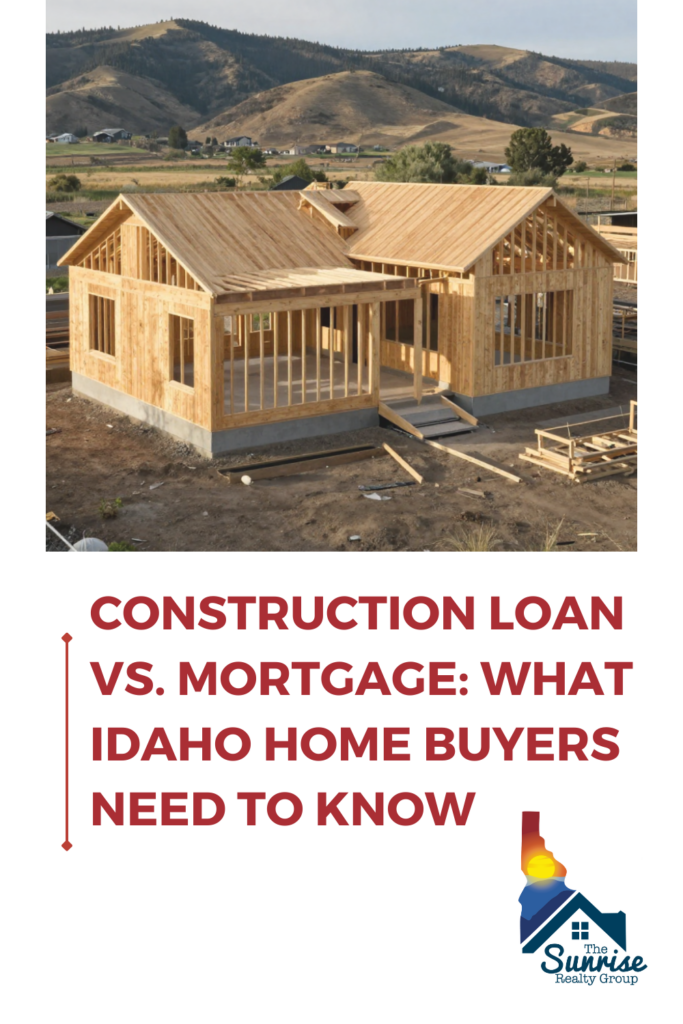
Understanding a construction loan vs. mortgage is one of the first financial steps to take if you’re planning to build a home in Idaho.
If you’re buying an existing or already-completed new construction home, permanent mortgage financing may be fairly straightforward. But if you’re buying land and building a custom home, the financing process can look very different.
Instead of paying for a finished property at closing, construction financing is designed to fund a project as the home is being built.
That difference affects when money is released, what your lender needs to approve, how payments may work during construction, and what happens when the house is finished.
Here’s what Idaho buyers should understand before choosing between a construction loan and a traditional mortgage.
What Is a Traditional Mortgage?
A traditional mortgage is long-term financing used to purchase a completed property.
This can include:
- An existing home
- A completed new construction home
- A home purchased directly from a builder after construction
- Other finished residential property that meets the lender’s requirements
With a typical mortgage, the lender funds the purchase at closing and the borrower begins making regular mortgage payments according to the loan terms.
The lender generally examines factors such as:
- Income
- Credit
- Debt-to-income ratio
- Available funds
- Property appraisal
- Loan program requirements
Because the house already exists, its current condition and value can be evaluated as part of the mortgage process.
One important distinction: conventional mortgage is not simply another name for every traditional mortgage. Conventional loans are one category of permanent mortgage financing. Depending on eligibility and the property, buyers may also use government-backed or other mortgage programs.
The main point is simple:
A traditional mortgage generally finances a completed home. A construction loan finances the process of creating one.
What Is a Construction Loan?
A construction loan is financing designed to pay eligible costs associated with building a home.
Depending on the lender, loan program, property, and transaction structure, construction financing may help cover costs such as:
- Land or lot acquisition
- Site preparation
- Excavation
- Utility installation
- Construction materials
- Builder labor
- Engineering
- Permits
- Other approved construction expenses
Unlike a traditional mortgage, the entire construction budget usually isn’t handed over at once.
Funds are generally released in stages, often called draws, as construction progresses.
For example, money may be released as the project reaches milestones involving the foundation, framing, mechanical systems, finishes, or other stages.
The lender may require inspections or other documentation before approving subsequent draws.
Construction Loan vs. Mortgage: What’s the Difference?
Both types of financing can ultimately help you become a homeowner, although they serve different purposes.
Traditional Mortgage
A traditional mortgage generally:
- Finances a completed home
- Funds the purchase at closing
- Uses the completed property as collateral
- Has long-term repayment terms
- Begins regular mortgage payments according to the loan agreement
- Requires a standard property appraisal and borrower underwriting
Construction Loan
Construction financing generally:
- Funds a home that hasn’t been completed yet
- Releases funds in stages during construction
- Requires lender review of the proposed project
- May involve interest-only payments during the construction phase
- Requires detailed plans, budgets, contracts, and other project information
- May require lender approval of the builder
- Must eventually be paid off or transition into permanent financing
That last point is especially important.
A construction loan is about building the house.
A permanent mortgage is about financing the finished house over the long term.
How Do Construction Loan Draws Work?
The draw process is one of the biggest differences between construction financing and a regular mortgage.
Instead of receiving the full construction amount upfront, funds are released as work is completed.
A simplified example could look like:
- Site work and excavation
- Foundation
- Framing
- Roofing and exterior
- Plumbing, electrical, and HVAC
- Drywall and interior work
- Finishes
- Final completion
The actual draw schedule depends on the lender, builder, contract, and project.
Before releasing another portion of the loan, the lender may require confirmation that the previous stage has been satisfactorily completed.
This gives the lender more oversight because the asset securing the loan is literally being created during the financing period.
How Payments Work During Construction
Construction financing may also handle borrower payments differently from a permanent mortgage.
Depending on the loan terms, borrowers may make interest-only payments during the construction phase based on funds that have actually been advanced.
As more funds are drawn, the outstanding construction balance can increase.
The exact payment structure, rate, and requirements depend on the lender and loan program, so buyers should review these details carefully before closing.
Don’t assume every construction loan works the same way.
The Main Types of Construction Financing
If you’re comparing a construction loan vs. mortgage, it helps to understand that there isn’t just one type of construction loan.
Two common structures are construction-to-permanent financing and construction-only financing.
Construction-to-Permanent Loan
A construction-to-permanent loan combines the construction phase and permanent mortgage financing into a coordinated transaction.
These are sometimes referred to as:
- Construction-to-permanent loans
- Construction conversion loans
- Single-close construction loans
- One-time-close construction loans
Exact terminology varies by lender.
During construction, funds are released according to the project’s draw process.
After the home is completed and the lender’s requirements are satisfied, the financing transitions into the permanent mortgage according to the loan terms.
The appeal is simplicity: the borrower can arrange the construction and permanent financing together rather than starting over with an entirely separate mortgage after the build.
However, borrowers should still understand how the permanent rate, loan amount, qualification requirements, appraisal, and other terms are handled.
Construction-Only Loan
A construction-only loan finances the building phase without automatically becoming the final long-term mortgage.
Once construction is complete, the construction financing must be paid off, commonly through permanent mortgage financing.
That creates two separate financial stages:
Construction financing → Permanent mortgage
This structure may provide flexibility when choosing the permanent financing, but it can also mean another underwriting process, another closing, and additional closing expenses.
The important question isn’t simply which one sounds easier.
It’s which structure works for your project and financial situation.
What About Renovation Loans?
Renovation financing is related to construction financing, but it serves a different purpose.
Rather than building an entirely new house, renovation loans may help finance the purchase or refinancing of an existing property along with qualifying improvements.
That could include substantial remodeling, structural changes, additions, or other approved work.
If your goal is to buy a fixer-upper rather than build on vacant land, ask your lender whether renovation financing makes more sense than a new-home construction loan.
How Construction Loans Work When Building in Idaho
The fundamentals of construction financing aren’t unique to Idaho, but the property and project still have to work within Idaho’s local development environment.
Your lender will want enough information to determine whether both the borrower and proposed construction project meet its requirements.
That can involve several areas.
The Property
The lender may need information about:
- The lot
- Ownership of the land
- Existing land debt
- Proposed home placement
- Access
- Utilities
- Site conditions
- Appraised value of the completed project
If you already own the land, the lender will need to understand how that property as well as any existing equity fit into the financing structure.
If you’re purchasing the lot as part of the construction transaction, the process may work differently.
The Builder
Construction lenders commonly have requirements for the builder participating in the project.
A lender may review items such as:
- Contractor information
- Experience
- Insurance
- Financial information
- Construction history
- Project documentation
- Contract terms
In Idaho, buyers should also verify the contractor’s applicable Idaho contractor registration.
Lender approval and state contractor registration are separate issues. A contractor meeting state requirements does not automatically mean every construction lender will approve that builder for its loan program.
Plans and Specifications
Before approving construction financing, the lender generally needs to understand what is actually being built.
Documentation may include:
- Building plans
- Site plan
- Specifications
- Engineering
- Construction contract
- Detailed budget
- Allowances
- Proposed schedule
A vague estimate for “a house around this size” isn’t enough to establish how much the project will cost or what the completed property should be worth.
The Appraisal
Appraising a proposed home is different from appraising a completed house.
The appraiser may evaluate the plans, specifications, site, and other project information to develop an opinion of what the property is expected to be worth when completed.
This matters because a home can cost a certain amount to build without necessarily appraising for exactly that amount.
For buyers, that means construction cost and completed market value need to stay connected throughout the planning process.
Why Construction Financing Requires More Project Information
A traditional mortgage finances an asset that already exists.
With construction financing, many important pieces are still in the future.
The lender is evaluating not only the borrower but also whether the proposed home can realistically be completed.
Possible issues can include:
- Construction delays
- Design changes
- Cost overruns
- Site problems
- Material changes
- Contractor issues
- Appraisal shortfalls
- Permit delays
- Unexpected property conditions
That’s why construction financing commonly involves more documentation and project oversight than purchasing a completed home.
It also explains why buyers should involve their lender early rather than waiting until plans and builder contracts are already finalized.
Construction-to-Permanent vs. Two-Closing Financing
For someone building a home, the long-term financing path often falls into one of two general categories.
Single-Closing Structure
With a qualifying construction-to-permanent structure:
- Construction and permanent financing are arranged together.
- Construction funds are advanced during the build.
- The home is completed.
- The construction phase moves into permanent mortgage financing according to the loan terms.
The main appeal is having a coordinated financing process from construction through long-term ownership.
Two-Closing Structure
With separate construction and permanent financing:
- You close on financing for construction.
- The home is built.
- You obtain permanent mortgage financing.
- The permanent loan pays off the construction financing.
Because these are separate transactions, buyers should understand the costs and qualification requirements for each stage.
Neither structure is automatically better for everyone.
Compare the complete financing picture rather than choosing based on one feature.
Do You Need a Construction Loan for Every New Home?
No.
This is an important distinction for buyers shopping for new construction.
If a builder owns the land, finances construction, completes the home, and then sells the finished property to you, you may purchase the completed home using ordinary permanent mortgage financing.
That’s very different from a custom-build situation where you own or purchase the land and finance construction yourself.
So don’t assume:
New construction = construction loan.
The financing depends on how ownership, construction, and the eventual purchase are structured.
Which Financing Option Makes Sense for You?
The right answer depends on what you’re actually buying or building.
A Traditional Mortgage May Make Sense If:
- You’re buying an existing home
- You’re purchasing a completed new construction home
- The builder is financing construction and selling you the finished property
- You don’t need to personally fund the construction process
Construction Financing May Make Sense If:
- You’re buying land and financing a custom build
- You already own land and are ready to build
- You’re responsible for financing construction
- Your project requires staged funding as work progresses
The lender should help determine which loan products you qualify for and which structures are available for your particular project.
Your real estate agent can help you evaluate a different part of the equation: whether the land, location, proposed home, and purchase structure make sense together.
Don’t Design the Entire House Before Understanding the Financing
One of the easiest mistakes to make is falling in love with a design before establishing what the total project can support.
That can create problems such as:
- Plans that exceed your construction budget
- A project that doesn’t fit lender requirements
- An appraisal that doesn’t support the proposed numbers
- Expensive redesigns
- Delays while plans or bids are revised
- Purchasing land that doesn’t work for the intended home
A better process is to bring the major pieces together early.
That generally means understanding:
- Your realistic total budget
- Preliminary financing options
- Land requirements
- Site costs
- Home design
- Builder pricing
- Local development requirements
These decisions affect one another.
Treating financing, land, design, and construction as completely separate decisions can create problems later.
Construction Loan vs. Mortgage: Start With the Bigger Picture
The biggest difference between a construction loan and a mortgage is what each one is financing.
A mortgage typically finances a completed home.
A construction loan finances the process of building one.
For Idaho buyers planning a custom home, however, the financing decision isn’t just about selecting a loan product.
The land has to support the home.
The design has to fit the budget.
The builder has to fit the project.
And the financing has to work with all three.
Sunrise Realty Group helps Treasure Valley buyers approach those pieces as one connected process instead of trying to solve each part independently.
Our 3-One Method brings together the land, home design, and builder so buyers can make better-informed decisions before committing to a project that doesn’t fit their goals.
If you’re thinking about building a home in Boise or elsewhere in the Treasure Valley, start with the complete picture.
The loan is one piece of it—but all the pieces need to work together.