
Author: Mike Carroll

  • Custom Home vs. Semi-Custom vs. Production: What’s the Difference?

    Custom Home vs. Semi-Custom vs. Production: What’s the Difference?

    By Sunrise Realty Group

    If you’re thinking about building a new home in Idaho, one of the first big decisions you’ll face is which path to take in the custom vs semi-custom vs production home conversation.

    In other words: do you want a fully custom home designed from a blank slate, a semi-custom home based on an existing floor plan, or a production (spec) home built by a tract builder in a planned community?

    Each type of home offers a different level of design flexibility, cost, and involvement in the home-building process. Understanding those differences clearly can help you make an informed decision that better aligns with your budget, timeline, and your family’s needs.

    This guide breaks down each type of home in clear, simple terms—so you can decide which option is the best fit for your lifestyle and long-term goals in the Treasure Valley.

    What Is a Production Home?

    A production home is the simplest and most affordable type of new construction. Production homes are typically built by tract builders (CBH Homes, Hubble Homes, Lennar, etc.) who are large production home builders who work from a set of pre-designed floor plans in a subdivision or master-planned community.

    Instead of starting with a blank slate, you choose from a set of standard floor plans offered by the builder. This allows the builder to streamline the construction process, control costs, and deliver high-quality homes at lower prices with less time from contract to move-in.

    Key Features of a Production Home

    Production homes usually share several characteristics:

    • A set of floor plans or house plans to choose from
    • Pre-designed structural layouts with less flexibility for changes
    • Standard finishes with upgrade packages for things like countertops, flooring, or paint colors
    • A predictable construction process with defined stages and timelines
    • Often built on smaller or uniform lots within the same neighborhood
    • Energy efficiency measures are commonly included as part of the builder’s standard package

    Many production builds are also referred to as spec homes or spec houses, especially when the builder starts construction before a specific buyer is under contract.

    Who a Production Home Is Best Suited For

    A production house is often the right choice for a:

    • Home buyer with a strict budget who still wants a new home
    • Buyers who prefer a move-in-ready home with fewer decisions to make
    • Families that want to be in a specific subdivision, school district, or community with amenities
    • Buyer who values a streamlined path and doesn’t need a high level of personalization

    For many people, production homes are an attractive option because they offer a lower cost of entry into new home construction and a shorter amount of time between signing a contract and receiving the keys.

    Pros of a Production Home

    • Lower cost compared to custom and many semi-custom builds
    • The fastest build time of the three options
    • Fewer decisions, which means less design fatigue
    • Clear base price and upgrade options upfront

    Cons of a Production Home

    • Limited design flexibility and structural changes
    • Less control over specific design elements or special features
    • Many homes in the community may share similar home designs and exterior materials

    What Is a Semi-Custom Home?

    A semi-custom home sits in the middle of the custom vs semi-custom vs production home spectrum. It blends flexibility with structure, and it’s often the best route for buyers who want more personalization than a production home—but don’t need the complete freedom (or full cost) of a true custom home.

    With a semi-custom home, you usually start with an existing floor plan from a semi-custom builder and then adjust it to your specific needs.

    Key Features of a Semi-Custom Home

    Semi-custom builds typically include:

    • A library of pre-designed floor plans or house plans to start from
    • The ability to make layout changes, such as moving walls, adding a bedroom, or reconfiguring the kitchen
    • A wider range of design options for finishes, fixtures, and exterior materials
    • More involvement in the design process, especially in the design phase
    • A mid-range price point between production and fully custom homes

    You’ll work with a design team or semi-custom builder to ensure the home’s construction reflects your lifestyle, specific needs, and price range.

    Who a Semi-Custom Home Is Best For

    A semi-custom home is often the best fit for:

    • Buyers who want a more personalized home without going all-in on a fully custom build
    • Families who have specific ideas about layout and storage but don’t need complete control over every detail
    • People who want a smoother, more structured process than a full custom project, but more design freedom than production homes

    Pros of a Semi-Custom Home

    • Greater level of personalization than production homes
    • The ability to adapt an existing floor plan to your family’s needs
    • A clearer starting point for budget and timeline than a complete custom build
    • Often, a good “middle ground” for many home buyers

    Cons of a Semi-Custom Home

    • More decisions to make than with a production home
    • Significant changes or structural changes can add additional cost.
    • The build may still take more time than a production home, especially if you request many modifications.

    What Is a Custom Home?

    A custom home offers the highest level of customization—and the most design freedom—among the three options. Here, you’re not starting with a standard plan or existing floor plan; you’re working with a custom home builder or design-build team to create a fully custom home from the ground up.

    Custom home projects usually start with a blank slate: your land, your ideas, and a design team that helps shape them into a complete set of house plans.

    Key Features of a Custom Home

    With a whole custom home, you can expect:

    • A fully original floor plan and architectural style
    • Complete control over room sizes, layout, and overall square footage design
    • The chance to incorporate specific design elements, special features, and unique home concepts
    • Tailored solutions to your land, views, and topography—especially if you own land already
    • The ability to specify exterior materials, energy efficiency features, and final finishes

    Custom home building is ideal for buyers who want their dream home to reflect a clear vision and specific needs that standard plans can’t meet.

    Who a Custom Home Is Best For

    A true custom home is often the right choice when:

    • You already own land or want to choose the land first and design around it.
    • You have detailed ideas about layout, architectural style, and special features.
    • You’re comfortable with a longer design-build process and a higher overall budget.
    • You want a one-of-a-kind home that doesn’t look like anything else in your neighborhood.

    Pros of a Custom Home

    • Complete control over the design process and final product
    • The highest level of personalization in layout, finishes, and performance features
    • Optimized use of your land, views, and site conditions
    • Potential for higher long-term value when done well

    Cons of a Custom Home

    • Typically, the highest cost and most extensive price range
    • The amount of time from the first decision to move-in is usually the longest.
    • Requires close coordination between your custom builder, design team, and lender
    • More decisions and more complexity throughout the construction process

    Custom vs Semi-Custom vs Production Home: Side-by-Side Comparison

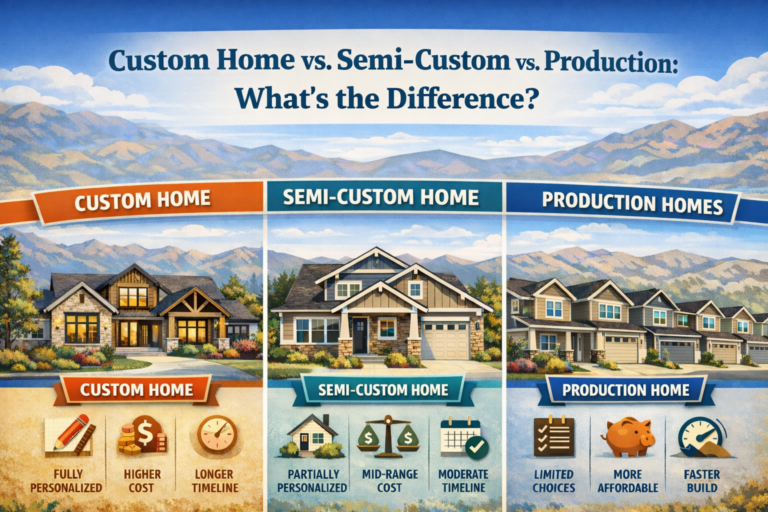
    When you line up custom vs semi custom vs production home options, the differences become clearer. Here’s a simplified way to think about them:

    FeatureProduction HomeSemi-Custom HomeCustom Home
    CostLowest base price / lower costMid-range, depends on changesHighest, widest price range
    Design FlexibilityLowest design flexibilityModerate level of customizationUnlimited design freedom
    TimelineFastest / less timeModerateLongest amount of time
    Floor PlansFixed set of floor plansPre-designed floor plans with modificationsFully original plans
    DecisionsFewer decisions to makeMore decisions, guided by builderMost decisions across all phases
    Best ForBudget-focused, move-in ready buyersBuyers wanting balance between cost & customizationBuyers wanting full control & unique design
    LandUsually builder-owned lotsOften can build on your own lotCommonly built on land you own or select

    This comparison can help you quickly see which path best suits your budget, timeline, and level of involvement.

    How to Choose the Right Type of Home (and Builder)

    When you’re deciding between custom vs semi-custom vs production home paths, it often helps to think in terms of:

    1. Budget and Price Range
      • If you need the lowest possible base price and a simpler path, production homes or spec homes can be an attractive option.
      • If you invest more in personalization, semi-custom builds, or full-custom homes, you can open up more possibilities.
    1. Level of Customization You Want
      • If you’re comfortable with a standard plan and a few design options, production builds may be the right route.
      • If you have specific needs for your family, a semi-custom home offers a good balance.
      • If you want complete control and a truly unique home, a fully custom build is the natural choice.
    1. Amount of Time and Involvement
      • Production homes tend to require less time and fewer decisions.
      • Semi-custom and custom houses involve more meetings, design decisions, and ongoing input, but also lead to a more personalized home.
    1. Land Situation
      • If you don’t own land and want a quick, streamlined path, production home builders with move-in-ready home options might be ideal.
      • If you already own land or want to select land first, a semi-custom builder or custom home builder can help you align the home design with your site.

    Working with the right builder is just as important as choosing the right type of home. Look for production builders, semi-custom builders, or custom builders with a track record of high-quality homes, clear communication, and expert guidance through the design-build process.

    Next Steps in Your Home Building Journey

    Choosing between custom vs semi-custom vs production home options is one of the first—and most important—decisions in the home construction journey. 

    There’s no single “right decision” that applies to everyone; instead, the best fit depends on your:

    • Budget and long-term goals
    • Desired level of design freedom
    • Willingness to be involved in the design process
    • Timeline for moving into your new home

    Idaho’s growing market offers all three paths, from production homes in master-planned communities to semi-custom builds and full custom home design on acreage or view lots.


    If you’d like expert guidance on which type of builder and which type of home is the best route for your situation, Sunrise Realty Group can help you sort through your options, clarify your priorities, and move confidently toward the home of your dreams.

    Contact us now.

    Differences between a custom vs semi custom vs production home; choose the right builder, budget, and design path for your new home in Idaho.

  • Idaho Construction Loans: How Much House Can You Build?

    Idaho Construction Loans: How Much House Can You Build?

    Building a home in Idaho is an exciting journey — and the very first question most people have about a construction loan is simple:

    “How much house can I actually afford to build?”

    Unlike buying an existing home with a traditional mortgage, new construction requires a home construction loan during the construction phase. These loans come with specific rules, lender requirements, and approval limits that directly impact your budget.

    Understanding Idaho construction loan limits helps you set a realistic plan, avoid surprises, and design a home that aligns with what lenders will approve. This guide explains loan types, down payment expectations, appraisal influences, and factors that affect your loan amount from start to finish.

    What Makes Construction Loans Different in Idaho?

    Construction loans are short-term, interest-only loans that cover:

    • Land
    • Site prep
    • Materials
    • Labor
    • Utilities
    • Permits
    • Engineering
    • Inspections

    Once the construction of a new home is complete, the loan converts into a permanent loan (also known as the end loan), or you close a construction loan and refinance into a longer-term fixed-rate mortgage.

    Unlike a traditional mortgage, construction financing requires:

    • More documentation
    • Approved architectural plans
    • A licensed Idaho builder
    • A detailed cost breakdown
    • A higher credit score
    • Verification that the project is feasible
    • A draw schedule for the construction period

    Construction costs fluctuate during construction and understanding lending limits before you design your home is crucial.

    How Construction Loan Limits Work in Idaho

    Construction loan limits depend on four major factors.

    1. Your Down Payment or Equity in the Land

    Most Idaho lenders require a down payment for primary home, secondary home or a vacant lot.

    If you already own the land, its value often counts as equity toward loan approval. A good amount of equity can significantly reduce the upfront cash required.

    Example:

    If your land is worth $150,000 and you own it free and clear, that value could possibly be treated as your down payment.

    2. The Type of Loan You Qualify For

    There are several different types of construction loans available in Idaho:

    • Conventional Construction Loans

    There are conforming loan limits in Idaho. These limits include both the land and the building of a new home. Anything above the conforming loan limits could possibly require a jumbo construction-only loan or a construction-to-permanent loan.

    • Jumbo Construction Loans

    For larger construction projects or higher market values.

    They require:

    • Strong credit history
    • Larger down payment
    • Clean credit approval
    • Proven financial stability
    • FHA Construction Loans

    FHA’s One-Time Close program allows lower down payments, but the FHA loan limit for Idaho (most counties)  including land and construction is lower.

    This makes FHA a better fit for modest construction projects or a smaller renovation project.

    VA Construction Loans

    VA loans offer zero-down options for eligible borrowers, but only certain credit unions and lenders in Idaho offer them.

    Lenders typically cap VA loans due to risk tolerance.

    3. The Appraised Value of the Finished Home

    Lenders use a “subject-to” appraisal meaning the home is appraised as if it were already built. The appraisal affects your final loan amount and whether private mortgage insurance may apply.

    If the appraisal comes in low, you may need to:

    • Increase your down payment
    • Negotiate prices down
    • Reduce square footage
    • Consider lower cost materials (siding, fixtures, appliances, etc)
    • Find ways to pay for certain things yourself

    This is one of the most important steps in the construction mortgage process.

    4. Your Debt-to-Income (DTI) Ratio

    Most Idaho lenders require a certain Debt-to-Income ratio (DTI) to qualify for for a loan. Ultimately it’s your DTI that determines the size of the monthly payments you can afford, which directly affects your construction loan product options.

    5. Top 5 Ways to Increase How Much House You Can Afford to Build

    • 1. Use land equity

    Land equity reduces cash needed and increases approval odds.

    • 2. Lower debts

    Reducing your credit card balances, personal loans or auto loans improves your DTI.

    • 3. Choose a design that appraises well

    Higher-end Idaho appraisals favor:

    • Simple rooflines
    • Efficient layouts
    • Functional square footage
    • Desirable areas
    • 4. Work with an Idaho lender experienced in construction loans

    Choose a reputable lender that is familiar with typical Idaho construction and draw schedules.

    • 5. Start with a realistic plan

    It is very common for home owners (especially first time home buyers) who are designing their own home to design themselves into a problem because they do not understand what things cost. 

    Frankly, no one can know what the construction cost is going to be without designing a home and having it bid out to the different trades involved in the construction process. Due to the nuances of building a new home, designing it exactly the way you want it and then bidding it out is the only way to know if you can truly afford the home. 

    With the 3-One Method however we are going to be able and assist you with this a little more than others due to our knowledge of the industry and our relationships with builders. Things change daily in terms of cost and having these relationships with different builders allow us to help give you a little more insight ahead of time.

    6. It is Important to Get Pre-Approved on Your Loan Ahead of Time

    Designing your home before knowing the construction loan limits is never a good idea. Getting a pre-approval on a loan before designing a home saves you from not wasting time and money. Knowing the loan amount allows the builder to know what you can afford and allows a builder (and a real estate agent) to guide you accordingly.

    Final Thoughts

    Understanding Idaho construction loans and how lenders calculate your maximum build budget is the first step in designing a home you can actually complete. When you know how the loan type, land equity, credit score and appraisal influence your approval, the construction process becomes much smoother.

    Whether you’re exploring a renovation loan, a new construction loan, an owner-builder construction loan or a full construction-to-permanent loan, getting clarity early can create a solution for your specific financial situation.

    If you want help:

    • Understanding how much home you can build
    • Evaluating a vacant lot or piece of land
    • Finding favorable terms with a reputable construction loan lender
    • Matching with a mortgage loan officer
    • Designing a plan that fits your loan amount and budget

    The Sunrise Realty Group is here to guide you every step of the way. Contact us today.

    Learn how Idaho construction loans work, loan limits, and how much home you can build. Understand construction loan requirements, down payments, and approval tips.
  • January 2026 Events & Activities Around the Treasure Valley

    January 2026 Events & Activities Around the Treasure Valley

    A Local Guide to Winter Living in Idaho

    Living in Idaho isn’t just about the home you live in—it’s about the community around it. Even in the heart of winter, the Treasure Valley offers a full calendar of events that bring neighbors together, support local venues, and showcase the lifestyle that makes this area such a great place to call home.

    Below is a week-by-week guide to real, actively promoted January 2026 events across Boise and the surrounding Treasure Valley. Each event includes a direct link so you can explore details, dates, and tickets.


    Week 1: January 1 – January 4

    Start the New Year Locally

    Great Train Show – Expo Idaho (January 3–4)
    A family-friendly event featuring massive model train layouts, vendors, and interactive displays at Expo Idaho.
    👉 Event website: https://www.greattrainshow.com
    👉 Venue calendar: https://expoidaho.com/event-calendar/


    Week 2: January 5 – January 11

    Sports, Music, and Local Entertainment

    Boise State Basketball Home Games – ExtraMile Arena (Multiple Dates)
    January brings several Boise State home games, drawing fans from across the valley for high-energy winter sports nights.
    👉 Schedule & tickets: https://broncosports.com
    👉 Venue info: https://www.extramilearena.com/events

    Live Music at the Riverside Hotel – Boise
    The Riverside Hotel hosts rotating live music performances throughout January, offering an easy night out close to downtown.
    👉 Event calendar: https://www.riversideboise.com/hotelevents2

    Comedy & Live Shows at the Egyptian Theatre – Boise
    One of Boise’s most historic venues continues to host touring comedians and performers during the winter season.
    👉 Upcoming shows: https://egyptiantheatre.net/calendar/


    Week 3: January 12 – January 18

    Home, Arts, and Community

    Idaho Remodeling & Design Show – Boise (January 17–18)
    A must-see event for homeowners, builders, and anyone thinking about upgrading or personalizing their space. Exhibitors showcase remodeling ideas, home products, and design trends.
    👉 Event details & tickets: https://www.eventbrite.com/e/idaho-remodeling-and-design-show-tickets-1215505512709

    Idaho Film Fair – Boise (January 17)
    Celebrating independent film and creative arts, this event brings filmmakers and audiences together for screenings and discussion.
    👉 Event information: https://jumpboise.org/events/idaho-film-fair

    Winter Blues Weekend – Boise (January 17)
    A live blues performance featuring regional and touring musicians, hosted by the Idaho Blues Society.
    👉 Event details: https://www.eventbrite.com/e/winter-blues-weekend-too-slim-the-taildraggers-tickets-1860516548079


    Week 4: January 19 – January 25

    Culture, Community, and Winter Nights

    Martin Luther King Jr. Day Community Events (January 19)
    Local organizations across the Treasure Valley host service projects, gatherings, and remembrance events honoring Dr. King’s legacy.
    👉 City events calendar: https://www.cityofboise.org/events/

    Skywatching: Moon & Saturn Conjunction (January 23)
    January skies offer a great opportunity for casual stargazing. This visible conjunction is a fun, free way to enjoy Idaho’s dark winter skies.
    👉 Skywatching guide: https://www.timeanddate.com/astronomy/night/


    Week 5: January 26 – January 31

    End the Month with Big Entertainment

    Moulin Rouge! The Musical – Boise (January 27 – February 1)
    A major Broadway touring production comes to Boise’s Morrison Center, offering world-class entertainment close to home.
    👉 Show details: https://www.morrisoncenter.com/events/detail/moulin-rouge-the-musical

    Idaho Laugh Fest – Boise (January 29–31)
    A multi-day comedy festival featuring national and regional comedians at venues across Boise.
    👉 Event info & tickets: https://www.eventbrite.com/e/idaho-laugh-fest-returns-vip-ultra-early-bird-tickets-1231708606599

    Live Music at Sapphire Room – Boise (January 30)
    Wrap up the month with live local music at one of Boise’s popular performance lounges.
    👉 Event calendar: https://sapphiresocietyboise.com/events


    Why Local Events Matter When Choosing Where to Live

    Events like these are more than just calendar entries—they reflect the lifestyle, culture, and community that come with living in the Treasure Valley. From family-friendly attractions and college sports to live music, arts, and home-design inspiration, January shows that Idaho remains active year-round.

    If you’re exploring neighborhoods, considering a move, or simply want to stay connected to what’s happening locally, keeping an eye on community events is one of the best ways to understand what life here is really like.

    If you’d like help finding homes near your favorite venues or neighborhoods that match your lifestyle, feel free to reach out—Idaho living is about more than just square footage.