
Commercial Zoning Explained: How Business Districts Control Use, Size, and Impact
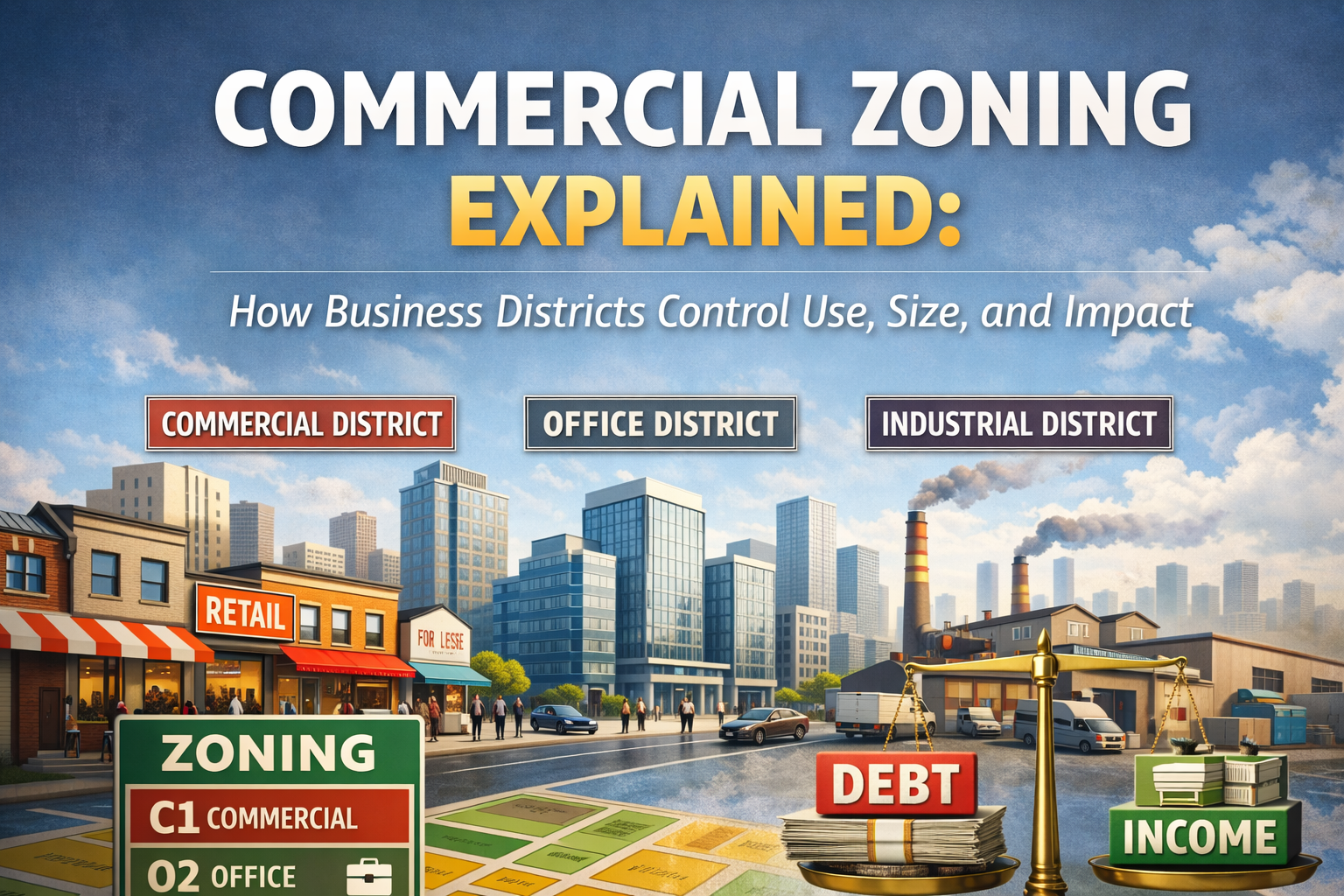
Commercial zoning explained in plain English comes down to this: if a property is zoned for commercial use, the rules become more complex. It is no longer just about what can be built there. It is also about how that business is allowed to operate and how it will interact with traffic, neighbors, utilities, parking, noise, lighting, and public infrastructure.
That is where misunderstandings get expensive fast.
Commercial zoning is not just about the structure itself. It is about the intensity of use and the effect it has on the surrounding area. Two properties that both appear “commercial” can have very different allowed uses, development standards, and long-term value.
For buyers, developers and business owners that matters early. A site may look like a strong fit on paper, but zoning rules may limit the type of business, the number of parking spaces, the placement of the building, or even the hours a property can realistically operate.
This article breaks down how commercial zoning works, what it regulates, and the issues you need to understand before purchasing or building on a commercially zoned property.
What Is Commercial Zoning?
Commercial zoning regulates land intended primarily for business, service and economic activity rather than residential living or agricultural production.
The goal is not simply to allow “business use.” Local governments use commercial zoning to concentrate business activity in appropriate areas, manage traffic and parking impacts, separate incompatible uses, support economic growth and protect nearby residential neighborhoods.
That is why commercial zoning does not mean anything business-related can go in the same spot or area. In most jurisdictions, commercial land is divided into multiple subcategories (like residential) each with its own rules, use limitations and development standards.
Commercial Zoning Explained by District Type
While zoning varies from one city or county to another, most commercial zoning categories fall into a few recognizable groups.
Neighborhood or Low-Intensity Commercial
Often labeled C-1, Neighborhood Commercial, or Local Commercial, these zones are usually intended to serve nearby residential areas.
Common uses may include small retail shops, coffee shops, professional offices, or personal service businesses such as salons and clinics. Because these areas often sit closer to homes, the rules are usually tighter. Drive-throughs may be restricted. Late-night operations may not be allowed. Building size, signage, and operating hours are often more controlled to reduce neighborhood impact.
General or Community Commercial
Often labeled C-2, General Commercial, or Community Commercial, these zones typically allow a broader range of business uses.
Larger retail stores, restaurants, medical and dental offices, banks, and service businesses are often found in these districts. At this level, traffic generation, parking requirement and access management become major factors. A property may be commercially zoned, but that does not automatically mean every commercial use will be approved the same way.
Heavy Commercial
Often labeled C-3, Heavy Commercial, these zones are designed for larger-scale, auto-oriented and higher-traffic uses.
Hotels, motels, big-box retail, gas stations, auto sales, auto service, and large restaurants or franchise uses often fall into this category. These districts may allow larger buildings, more signage, and extended hours, but they also tend to require more extensive parking, circulation planning and traffic review.
What Commercial Zoning Regulates
Commercial zoning controls far more than whether a building can sit on a parcel. It regulates how the site functions, how intense the use can be, and how the property affects the public realm around it.
Permitted Uses and Use Intensity
One of the most important parts of commercial zoning is the use table.
Zoning codes typically categorize businesses into uses allowed by right, uses requiring a conditional use permit and uses prohibited. That distinction matters because two businesses that sound similar in everyday conversation can be treated very differently under zoning rules.
A small retail shop and a restaurant, for example, may both sound like normal commercial uses. In reality, a restaurant may trigger increased parking demand, increased waste-handling requirements, increased delivery activity and longer operating hours. In commercial zoning, use intensity matters almost as much as use type.
Parking Requirements
Parking is one of the most restrictive parts of commercial zoning.
Requirements are often based on square footage, seating capacity, number of employees or the exact type of business operating on the site. A property can be physically attractive and structurally sound but still become difficult to use if it cannot meet parking standards for the intended tenant or owner.
Insufficient parking can delay approvals, require shared parking agreements, limit future tenant changes, or reduce resale value. In some cases, a building is not functionally obsolete because of its structure or the site cannot meet modern parking requirements for the use.
Building Placement and Setbacks
Commercial zoning also controls where a building can sit on the lot.
Setbacks may apply to streets, property lines and adjacent residential areas. When a commercial property borders a neighborhood, the zoning code often requires more separation. That may include increased setbacks, landscaped buffer yards, fencing, walls or screening to reduce noise, lighting and visual impact.
Height and Massing Controls
Commercial districts often allow more height than residential zones, but height is still regulated.
Height limits may increase with distance from residential neighborhoods, tighten near residential edges, or be affected by airport overlays, view corridors or other planning restrictions. In many cases, it is not just the number of stories that matters. Building mass, setbacks and overall scale can also shape what is allowed.
Lot Coverage and Floor Area Ratio (FAR)
Commercial zoning often uses floor area ratio, or FAR, to control development intensity.
FAR affects total leasable area, project feasibility, return on investment and future expansion potential. A higher-FAR parcel may support far more value than a similar-looking property in a lower-intensity zone. On the other hand, a low-FAR site can quietly cap development potential even when demand for the location is strong.
For investors and developers, this is where zoning starts to affect land value in a very real way.
Traffic, Access and Site Design
Commercial properties generate traffic and zoning rules reflect that reality.
Many sites are subject to regulations around driveway spacing, ingress and egress, cross-access, circulation patterns, traffic impact studies or road improvements such as turn lanes and signal work. A zoning district may technically allow a use, but poor access design can keep a project from moving forward smoothly.
That is one of the biggest differences between simply reading a zoning label and truly understanding a site.
Easements and Utilities in Commercial Zones
Commercial properties often contain more site constraints than buyers realize at first glance.
Utility corridors, drainage easements, access easements, shared driveways and cross-access agreements can all affect layout, buildable area and future flexibility.
Do to commercial sites often maximizing lot use, these constraints can significantly reduce usable square footage or complicate redevelopment plans.
Commercial Zoning Near Residential Areas
One of the most sensitive zoning transitions is where commercial and residential districts meet.
In those cases, zoning often imposes reduced height limits, increased setbacks, stronger landscaping buffers, and tighter restrictions on lighting, noise and hours of operation. That means two commercially zoned properties can have very different development potential depending on what surrounds them.
A commercial parcel on a busy corridor may support a much more intense use than a similar-sized parcel located directly next to homes. The zoning label may look the same, but the practical outcome may not be.
Common Misconceptions About Commercial Zoning
Many costly mistakes in commercial real estate start with assumptions that sound reasonable but do not hold up under review.
One of the biggest is the belief that commercial zoning means any business is allowed. It does not. Use lists are specific and many are more restrictive than buyers expect.
Another common mistake is assuming that if one business works nearby, another similar business will work on the next parcel. Not necessarily. Parking ratios, site layout, access, adjacency and use intensity can all change the answer.
It is also a mistake to assume zoning approval guarantees operational success. Zoning may allow a use, but it does not guarantee that the project is practical, efficient, profitable or easy to build.
Many people underestimate how difficult it can be to convert residential land to commercial use. Rezoning is often political, uncertain and time-consuming.
Why Commercial Zoning Requires Deeper Analysis
Commercial zoning affects far more than the label on a map.
It affects tenant flexibility, parking feasibility, traffic impacts, construction cost, future expansion, long-term property value and investor exit strategy. A site that looks workable for one business may be difficult to lease, resell or repurpose later if the zoning constraints are too narrow.
That is why zoning mistakes in commercial real estate can turn into six- or seven-figure problems. The risk is not just whether something can be built. The real question is whether the site can support the intended use in a way that is functional, financeable and sustainable.
For buyers, developers and business owners, commercial zoning should never be treated like a quick box to check. It deserves a closer read before a purchase, a build or a long-term investment decision.
How Commercial Zoning Fits Into the Bigger Zoning Conversation
Commercial zoning is where land-use rules start to become more layered.
It introduces greater complexity, greater regulatory scrutiny and more coordination with public agencies than most residential zoning questions do. It also serves as a bridge to mixed-use districts, planned developments, overlay zones and other advanced land-use frameworks, where the rules become even more detailed.
Once you understand how commercial zoning controls use, size, intensity and impact, it becomes much easier to judge whether a property is actually a fit for your goals, rather than just commercially labeled in a way that sounds promising.
If you’re looking at commercial property and want help making sense of zoning, development potentia, or next steps, Sunrise Realty Group is here to help. Reach out to start the conversation.